
How to Improve Work Performance: Quick Productivity Boost
If you want to boost your work performance, you have to get intentional with your time. It’s not about finding more hours in the day but about getting more out of the hours you have. This means moving past a simple to-do list and building a real system—one that helps you separate the urgent from the truly important and carve out time for deep, meaningful work.
Master Your Time to Maximize Your Output
Ever feel like you’re constantly busy but not getting anything done? That’s not a calendar problem; it’s a system problem. The highest performers aren’t superhuman—they’ve just figured out how to make their time work for them, not against them. The first step is to get brutally honest about where your time is actually going.

Conduct a Personal Time Audit
Before you can fix the leaks, you have to find them. For the next three to five days, track what you’re doing in 30-minute blocks. Don’t cheat—log everything from that critical project work to the five minutes you spent scrolling through social media.
This little exercise is an eye-opener. You’ll quickly see the hidden patterns, like how much time you lose switching between tasks or getting sucked into low-value admin work.
Once you have your data, sort each time block into a few simple categories:
- High-Impact Work: Tasks that directly move the needle on your biggest goals.
- Necessary Admin: The emails, scheduling, and routine stuff that has to get done.
- Distractions: Interruptions and any unplanned, non-work detours.
- Recharge Time: Your lunch break, short walks, and any moment you step away to clear your head.
Now you have a clear, data-driven map of your days, making it obvious where the opportunities for improvement lie.
Implement a Proven Time Management Framework
With your audit done, it's time to build a better system. A huge part of this is learning how to prioritize tasks effectively so you're always focused on what matters most. A couple of battle-tested frameworks can give your day the structure it needs.
This is especially critical now. With the rise of remote work, we're all our own managers. In fact, fully remote employees tend to gain about 29 minutes of productive time each day, largely because they face fewer in-person interruptions. It just goes to show how much power you gain when you take control of your environment and schedule.
Key Takeaway: Improving your work performance starts with intentionality. It's about designing your day around your priorities, rather than letting your day happen to you.
Choosing the right system for you is what makes this stick. You need a method that aligns with your specific work style and the challenges you face every day.
Choosing the Right Time Management Technique
| Technique | Best For | Key Benefit |
|---|---|---|
| Time Blocking | Creatives, developers, and anyone needing long stretches of uninterrupted focus. | Protects your calendar for deep work, preventing your schedule from filling with meetings. |
| Eisenhower Matrix | Managers, entrepreneurs, and people facing constant competing demands. | Forces you to distinguish between urgent and important tasks, clarifying what to do, delegate, or delete. |
| Pomodoro Technique | Those who struggle with procrastination or get easily distracted. | Breaks work into manageable 25-minute intervals, making it easier to start and maintain focus. |
Each of these techniques can be a game-changer, but finding the one that feels natural is the key to consistency.
For those long, focused work sessions, maintaining your energy without the jitters is non-negotiable. While a quick coffee can help, the inevitable crash often does more harm than good. To stay sharp and productive, consider options designed for smoother, more stable energy. A long-lasting boost from sustained-release caffeine can help you power through your most important work blocks without the rollercoaster effect. You can purchase products with sustained-release caffeine directly from our website.
Cultivate Deep Focus in a Distracted World
In a world overflowing with pings, notifications, and endless "urgent" requests, your ability to concentrate is a superpower. It’s what separates good work from truly exceptional results. The capacity for deep, uninterrupted focus isn't something you're born with—it's a skill you train.

This is where the concept of "deep work" comes in. It’s about performing professional activities in a state of distraction-free concentration, pushing your mind to its limits. This is the zone where you solve tough problems, produce high-quality creative work, and learn difficult skills quickly.
The opposite is "shallow work"—logistical tasks that don’t demand much brainpower, like answering routine emails. The danger is that shallow work feels productive and easily fills our days, leaving no room for the deep work that actually moves the needle.
Design Your Environment for Focus
Let's be honest: willpower alone is a losing battle against distraction. Your environment will always win. So, instead of trying to resist temptation, the smarter move is to remove it entirely. This is called environment design, and it’s the most effective strategy for cultivating real focus.
A few simple tweaks can make a world of difference:
- Silence the Pings: Turn off all non-essential notifications. That means email pop-ups, social media alerts, and news updates on your computer and phone. Be ruthless.
- Clear Your Space: A cluttered desk often leads to a cluttered mind. Keep only the tools you need for the task at hand within arm's reach.
- Signal Your Status: Noise-canceling headphones are a universal sign for "I'm in the zone." You can also set a "Do Not Disturb" status on your messaging apps to let colleagues know you're unavailable.
These aren't just minor adjustments; they create a powerful shield against the constant interruptions that shatter your attention.
Deep work isn't some mystical state. It's the natural outcome of a well-designed system. When you control your environment, you control your ability to produce high-value work.
Ditch Multitasking for Monotasking
The myth of multitasking is one of the biggest productivity killers out there. Research has shown time and again that the human brain isn't built to focus on multiple complex tasks at once. What we call "multitasking" is really just rapid context-switching, and it comes with a steep cognitive cost.
Every time you jump from a project brief to an email and back again, your brain has to re-engage, burning through precious time and mental energy. The antidote is simple: monotasking. Give your full, undivided attention to one thing at a time.
When you fully immerse yourself in a single task, you can enter that peak performance state often called "flow." Getting there requires dedicating uninterrupted blocks of time to your most important projects. We have a full guide that explains how to achieve a flow state and make it a regular part of your routine. This is how you produce outstanding work in record time. Shop our focus-enhancing products to help you get in the zone.
5. Use Technology and AI to Work Smarter, Not Harder
Let’s be honest, the right tech can feel like a superpower. When used correctly, technology and AI aren’t just another distraction—they’re tools that multiply your effort, clearing the deck so you can focus on the work that actually matters. It's all about building your own 'productivity stack' that targets your unique workflow snags.
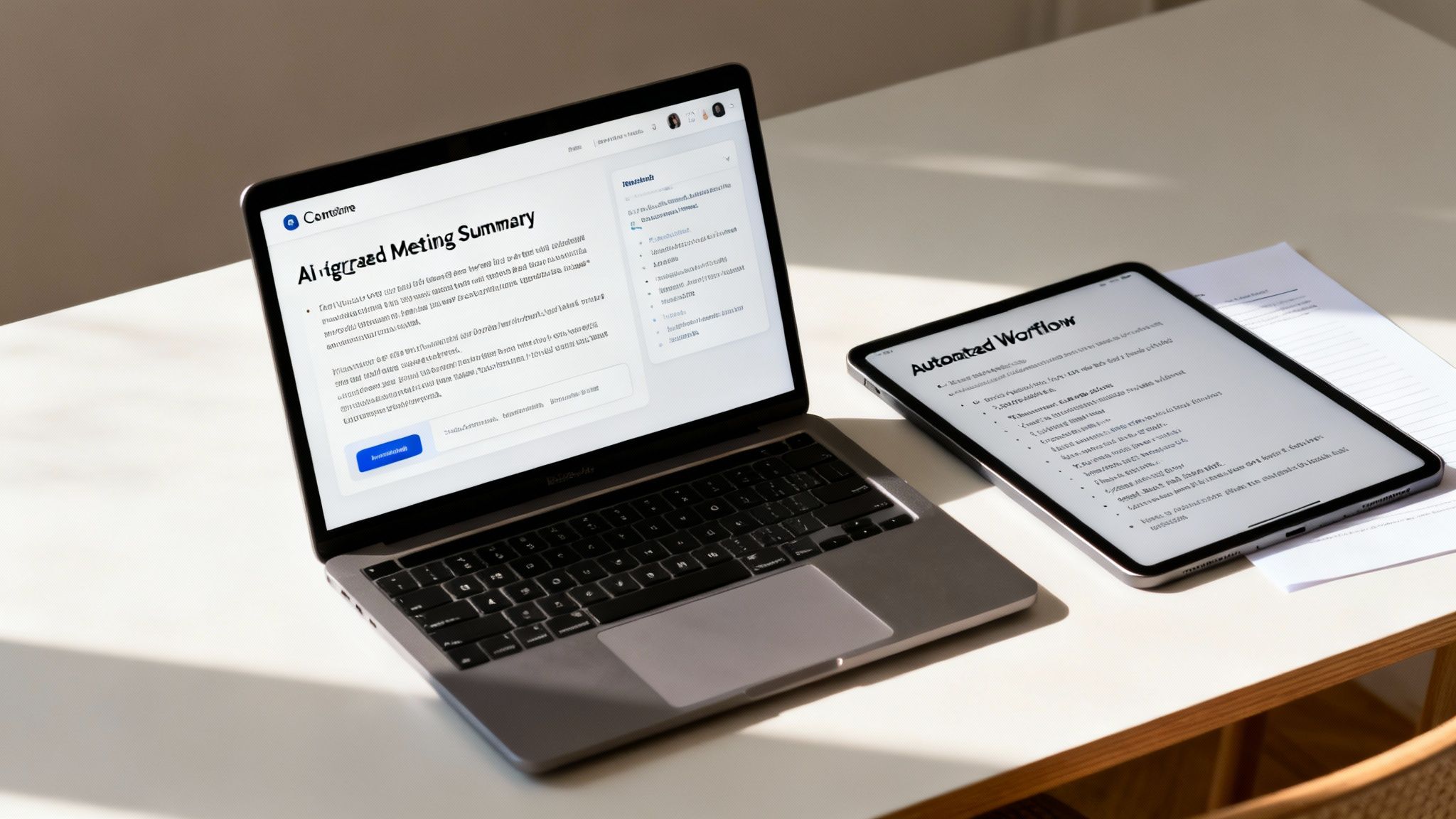
This isn't just a feeling; the numbers back it up. Companies that really weave AI into their daily operations see a massive 72% jump in productivity. On an individual level, 75% of knowledge workers report that AI helps them save time, sharpen their focus, and even think more creatively. You can dig into more of these employee productivity statistics and their impact to see the full picture.
Pinpoint What to Automate First
Before you jump on the latest AI trend, pause and look at your own day-to-day grind. Where do you get bogged down? Identify the tasks that are repetitive, drain your time, and don’t require your full brainpower.
Those are your golden opportunities for automation. Think about things like:
- Meeting Recaps: Stop trying to type notes while listening. Use an AI tool to transcribe and summarize your calls automatically.
- Repetitive Emails: If you send the same type of update every week, create a template. Use tools that can pull in the details for you.
- Data Entry: Set up simple automations to move information between apps, like from a form to a spreadsheet.
By offloading these low-level tasks, you claw back valuable hours each week for the high-impact work that only you can do.
Here's the secret: improve your work performance by automating the mundane so you can focus on the meaningful. Your brain is your most valuable asset—stop wasting it on copy-and-paste.
Build Your Personal Productivity Stack
There’s no magic bullet app that works for everyone. The best set of tools is the one that fits your job, your industry, and how you like to work. Think of it like building a custom toolkit, not just buying a pre-made set from the store.
A solid stack usually includes a few key players:
- A Project Manager: A central hub like Asana or Trello to track tasks, deadlines, and team progress.
- A Communication Tool: Something like Slack or Microsoft Teams to keep team chats organized and out of your inbox.
- An AI Assistant: A partner like ChatGPT or Gemini to help you brainstorm, draft content, or make sense of data.
- A Note-Taking App: A digital brain like Notion or Evernote to capture ideas and keep information organized.
The goal is to pick tools that play well together, creating a seamless flow. Of course, even the best tech can’t replace your own mental energy. For those times you need a clean, immediate boost to power through a tough project, check out our guide on the best caffeine gum for immediate focus. You can buy our top-rated Dialed In Nootropic Gum here.
Optimize Your Health for Peak Professional Performance
Let's be real: high performance at work isn't built between nine and five. It’s forged in the hours before you log on and after you log off.
Your professional output is a direct reflection of your physical and mental well-being. Think of your body and mind as the engine driving your career—if you neglect the maintenance, you can't expect it to run smoothly.

This isn't just fluffy wellness talk. The connection between your lifestyle and your output is deeply scientific. Quality sleep, smart nutrition, and regular exercise are fundamental inputs for cognitive functions like problem-solving, memory, and creative thinking. Small, consistent habits here lead to huge gains in your daily energy and focus.
The Foundational Role of Sleep
Everything starts with rest. We’ve all been there—skipping sleep to hit a deadline. It feels like a necessary evil, but it’s a classic trap of counter-productivity. A sleep-deprived brain struggles to focus, makes more mistakes, and has a harder time regulating emotions. That’s a recipe for a terrible workday.
You need to aim for 7-9 hours of quality sleep every night. It's not just about the number of hours, but the depth of your rest. You can improve it by setting a consistent sleep schedule (yes, even on weekends), making your room dark and cool, and ditching screens for at least an hour before bed. Understanding the profound health benefits of quality sleep is the first step to making it a non-negotiable part of your routine.
Fuel Your Brain with Smart Nutrition
The food you eat is literally the fuel for your brain. A diet packed with processed foods and sugar leads to energy crashes and mental fog, directly tanking your ability to handle complex tasks. You wouldn't put cheap gas in a high-performance car, so why do it to your brain?
Start swapping in some brain-boosting foods:
- Complex Carbohydrates: Oats, quinoa, and whole grains give you a steady release of energy, not a quick spike and crash.
- Lean Proteins: Chicken, fish, and legumes are crucial for supporting neurotransmitter function.
- Healthy Fats: Think avocados, nuts, and olive oil. These are essential for long-term brain health.
And don't forget water. Even mild dehydration can mess with your concentration and short-term memory. The easiest fix? Keep a water bottle on your desk and sip on it all day.
Your diet is one of the most powerful levers you can pull to improve your work performance. A clean diet leads to a clear mind and sustained energy, eliminating the afternoon slump that kills productivity.
Move Your Body to Sharpen Your Mind
If you’re looking for one of the most effective ways to kill stress, boost your mood, and sharpen your thinking, it’s exercise. Getting active increases blood flow to the brain, which helps grow new neurons and strengthens the connections between brain cells.
You don’t have to run a marathon. Just 20-30 minutes of moderate activity—a brisk walk, a bike ride, or a quick gym session—can have an immediate and noticeable impact on your focus and creativity that lasts for hours.
To round out these healthy habits, targeted nootropics can offer an extra edge. To see how you can support your brainpower even further, check out our guide on the best supplements for mental clarity: https://focuspouches.com/blogs/news/best-supplements-for-mental-clarity. When you combine a solid lifestyle with smart supplementation, you create an unbeatable foundation for hitting your professional goals. You can purchase our full line of supplements directly on our website.
Turn Continuous Learning and Feedback Into Fuel
In a world where industries can shift on a dime, standing still is the biggest risk to your career. The top performers I know aren't just great at what they do now; they're obsessed with getting ready for what's next.
This isn't about just grabbing random online courses. Real growth comes from zeroing in on the skills that will actually move the needle for you. A simple trick? Look at job descriptions for roles a level or two above yours. What tools, skills, or certifications pop up again and again? That's your roadmap.
The Art of Proactive Feedback
You can't get better in a vacuum. It’s nearly impossible. We all have blind spots, and the only way to see them is by getting an outside perspective.
Most people just wait for their annual performance review, but by then, it's usually too little, too late. The real pros seek out feedback constantly.
Don't just ask your boss, "How am I doing?" That’s way too broad. To get genuinely useful insights, you have to get specific.
- "What's one thing I could change in my project updates to make them more helpful for you?"
- "Thinking back on my last presentation, was there any part that felt unclear or could have been punchier?"
This turns feedback from a scary, once-a-year event into a normal, everyday part of getting better.
Feedback is a gift, even when it’s hard to hear. It's the fastest path to closing the gap between the work you're doing and the impact you want to have.
Turn Criticism Into an Action Plan
Getting the feedback is only step one. The real magic happens when you actually do something with it. Your job is to translate those observations into a concrete plan.
For example, if a teammate mentions your meeting summaries are too long and dense, don't just try to "write shorter." Create a system. Maybe you build a simple, one-page template with sections for key decisions, action items, and owners.
Suddenly, a piece of criticism becomes a tool that improves your output for good. This process also keeps your mind sharp, and you can explore more ways to improve your working memory to better absorb and apply these lessons.
And finally, always close the loop. A few weeks after you start using that new template, check back in with that person. "Hey, I've been using a new format for my meeting notes based on your feedback. Is this clearer for you?"
This small step does two huge things: it proves you value their input and makes them want to help you again in the future.
Time to Get After It
Boosting your performance at work isn't about some massive, overnight transformation. It’s about stacking small, smart habits that build on each other, day after day. We’ve covered everything you need to own your time, lock in your focus, make tech work for you, and turn feedback into fuel. Now, the ball is in your court.
Don't get overwhelmed and try to change everything at once. That's a recipe for failure. Instead, pick just one thing that clicked with you—maybe it's the time blocking technique or finally creating a workspace that isn’t distracting—and just nail it for a week. Once that feels natural, layer in the next thing.
The real goal here is building a system for sustainable productivity and career growth, not a fast track to burnout. It's a marathon, not a sprint.
This whole journey is about consistent, intelligent effort. And to help keep you sharp and energized along the way, we developed our own line of performance-enhancing tools.
For a clean, focused buzz without the jitters or the crash, check out our Dialed In Nootropic Gum. It's designed to support you when you need it most.
Take that first small step today. The high-performance career you want is built one good habit at a time. Your future self will thank you for it.
Common Questions Answered
Even with the best strategies, you're bound to hit a few roadblocks when trying to level up your work performance. Here are some quick, real-world answers to the questions I hear most often.
How Can I Improve My Work Performance When I Feel Totally Unmotivated?
When motivation disappears, the last thing you want to do is stare at a massive project. The trick is to focus on creating momentum, not climbing the entire mountain at once.
Break down your biggest task into the smallest possible step you can take. I'm talking tiny. Like, "open the document" or "write one single email subject line." Completing these micro-tasks gives you a quick win, which builds just enough energy to tackle the next tiny step.
It also helps to reconnect with your "why." Take 30 seconds to remember why this task actually matters to your team, your goals, or the company's mission. And hey, there's no shame in a little self-bribery. Setting a small, personal reward for getting through a tough job can be the exact push you need.
What's the Single Best Way to Eliminate Distractions?
The most powerful method by far is environment design. It’s the practice of proactively removing distractions before you even sit down to work. It’s a game-changer because you stop relying on willpower to resist temptation and simply remove the temptation altogether.
Here’s what this looks like in practice:
- Put your phone on silent and move it to another room. Out of sight, out of mind.
- Close every single browser tab that isn't essential for the task at hand.
- Throw on a pair of noise-canceling headphones to drown out office chatter or household noise.
When you curate a space that's built for deep work, you make focus the default setting, not a constant struggle.
How Long Until I See Real Improvements in My Performance?
You can actually feel small wins almost immediately. The very first day you try a technique like time blocking, you'll likely leave work feeling more in control and accomplished. Those daily boosts are powerful.
But for significant, lasting change, it's all about consistency. Turning these actions into second-nature habits usually takes anywhere from one to three months of steady effort.
The key is to prioritize consistent practice over perfect execution. Don't beat yourself up over an off day—it happens to everyone. Just get back to your system the next day. That's how real, long-term results are built.
For those days when consistency feels like a battle and your focus is fading, Dialed In Nootropics offers a clean, effective edge. Our scientifically formulated products are designed to sharpen mental clarity and provide a smooth, crash-free stream of energy.
Check out our collections and find the right tool to support your journey to peak performance at focuspouches.com. You can purchase all our products directly from our website by clicking here.