

How to Overcome Brain Fog and Reclaim Your Focus
Getting rid of brain fog isn't a one-and-done fix. It starts with identifying what's causing it in the first place—things like poor sleep, constant stress, or nutritional gaps—and then making targeted changes to your lifestyle. You can seriously speed up the process by adding responsible cognitive enhancers to the mix, helping you get back to feeling sharp and clear.
Your First Step to Overcoming Brain Fog Today
Feeling stuck in that persistent mental haze isn't just frustrating; it’s a signal from your brain that something is off balance. If you’re constantly battling to concentrate, remember simple things, or just think clearly, you’re not imagining it. And you’re definitely not alone.
In fact, new data shows that around 16.5 million working-age adults in the U.S. now report significant cognitive limitations. That number has shot up since early 2020, with adults aged 18-44 getting hit the hardest.
This guide is designed to cut through the noise with a practical action plan you can start right now. Forget the idea of a massive life overhaul. We're focused on small, smart changes that deliver real results.
Pinpoint Your Personal Fog Triggers
The first move is to become a detective of your own habits and lifestyle. Brain fog isn’t a one-size-fits-all problem, and the root causes can be surprisingly different from person to person. You need a fast way to figure out your biggest personal triggers.
Is it that inconsistent sleep schedule? The constant background stress you've gotten used to? Or maybe it's something in your diet. This decision tree lays out the most common starting points for diagnosing your brain fog.
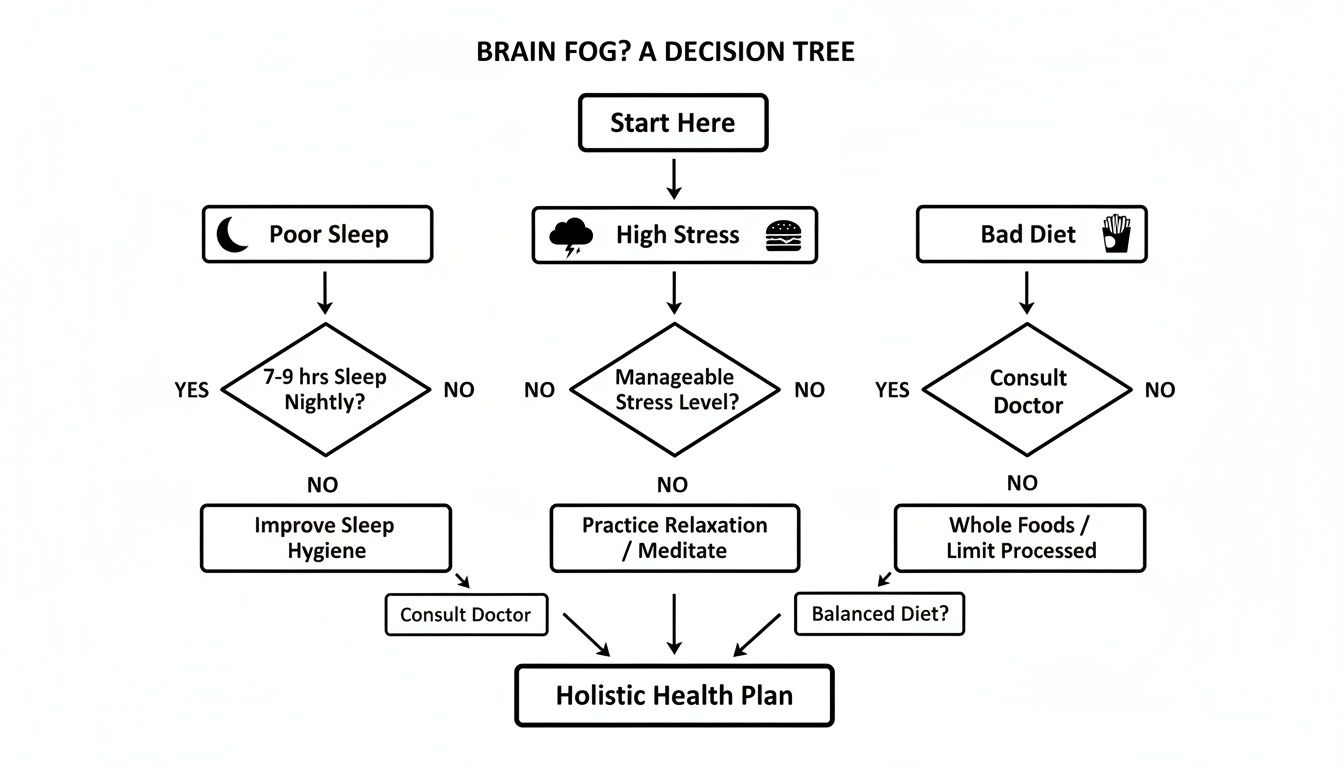
The main takeaway here is that a bunch of seemingly unrelated lifestyle factors often funnel down to the exact same outcome: a foggy mind that just can't keep up.
To get started, let’s quickly audit your lifestyle with a checklist. It's a simple way to zero in on what might be fueling your brain fog.
Quick-Start Brain Fog Diagnostic Checklist
| Symptom/Habit | Frequency (Daily/Weekly) | Potential Impact on Brain Fog | First Action Step |
|---|---|---|---|
| Less than 7 hours of sleep | Daily | High (Disrupts memory consolidation) | Set a consistent bedtime for one week |
| High caffeine intake (4+ cups) | Daily | High (Causes crashes, disrupts sleep) | Cut intake by 25% for 3 days |
| Skipping meals / erratic eating | 3+ times/week | High (Causes blood sugar instability) | Eat a protein-focused breakfast daily |
| High-sugar or processed foods | Daily | Medium-High (Triggers inflammation) | Swap one sugary snack for fruit/nuts |
| Low water intake (< 64 oz) | Daily | Medium (Dehydration impairs focus) | Drink a glass of water upon waking |
| Prolonged sitting (> 2 hours) | Daily | Medium (Reduces blood flow to the brain) | Take a 5-minute walk every hour |
| High-stress work/life events | Weekly | High (Elevates cortisol, impairs thinking) | Practice 5 minutes of deep breathing |
Run through this list honestly. The goal isn't to fix everything at once. It’s to find the one or two areas where a small tweak can give you the biggest return in mental clarity. This targeted approach makes clearing the fog feel manageable, not overwhelming.
A Foundational and Supportive Approach
As you start dialing in these foundational habits, targeted cognitive support can give you a much-needed boost. This is where a well-formulated nootropic comes in handy, helping you feel the benefits of a clearer mind much faster.
For instance, the ingredients in our Dialed In Nootropic Pouches are specifically chosen to support focus and cut through mental fatigue. When you combine smart lifestyle adjustments with effective support, you create a powerful synergy that accelerates your progress. You can dive deeper into the common causes of brain fog and fatigue in our detailed article. This dual strategy helps you not only clear the fog but also build up your resilience against it coming back.
Master Your Sleep to Defeat Mental Fatigue
Think of sleep as your brain’s non-negotiable, nightly deep-clean cycle. When that process gets cut short or disrupted, even a little, the mental fog rolls in the next day. This is your playbook for moving past the generic "get 8 hours" advice and actually mastering your sleep to shut down brain fog for good.
The link between a tired brain and a foggy brain isn’t just a feeling—it’s a massive problem. Brain fog has become a global epidemic, quietly sabotaging careers and daily performance.
In one major study, 28.2% of 25,796 people reported struggling with it. The issue peaked for those around 35 years old and was 20% more likely in females. You can read the full study on brain fog prevalence here.
This is exactly why optimizing your sleep isn't a luxury. It's the single most powerful tool you have to get clear again.
Align with Your Natural Circadian Rhythm
Your body runs on a 24-hour internal clock called the circadian rhythm. This is what controls your sleep-wake cycle, energy levels, and even hormone release. When your lifestyle fights against this clock, you get brain fog. The trick is to work with it.
Here’s how to start syncing up, even if your schedule is a mess:
- Lock In Your Wake-Up Time: This is the anchor. Waking up at the same time every single day—yep, even on weekends—stabilizes your internal clock way more effectively than a strict bedtime.
- Get Morning Sunlight: Step outside for 10-15 minutes within an hour of waking up. The specific light wavelengths in morning sun tell your brain to kill melatonin production and fire up alertness for the day.
- Manage Light Strategically: Your rhythm is incredibly sensitive to light. Get bright light during the day to reinforce wakefulness, then dim everything in the evening to signal that it's time to wind down.
Key Takeaway: Consistency beats duration. Seven hours of solid, high-quality sleep on a regular schedule will crush ten hours of erratic, broken sleep every single time when it comes to clearing brain fog.
Create Your Ultimate Sleep Sanctuary
Your bedroom is either helping you get restorative sleep or actively working against it. The goal is a space that signals safety and relaxation to your brain, making it easier to fall and stay asleep.
The quality of your sleep has a direct impact on your mood and mental clarity. It's tough to beat brain fog when your environment is the problem, and a big part of that is your bed itself. It’s worth understanding how your mattress affects your mood and mental health to get this piece of the puzzle right.
Dial in these three environmental factors:
- Cool It Down: The sweet spot for sleep is between 60-67°F (15-19°C). Your body's core temperature has to drop to initiate sleep, and a cool room makes that happen.
- Make It Dark: I’m talking total darkness. It’s essential for proper melatonin production. Use blackout curtains, cover up tiny LED lights on electronics, and don't be afraid to use a good sleep mask.
- Keep It Quiet: Random noises can yank you out of the deep, restorative sleep stages where the real magic happens. A white noise machine or simple earplugs can create a consistent, peaceful backdrop.
The Non-Negotiable Wind-Down Routine
You can't go from 100 mph to a dead stop the second your head hits the pillow. You need to give your brain a runway. A consistent wind-down routine is a powerful psychological cue that signals the shift from a stressful day to a state of rest.
Aim for 30-60 minutes, and make it completely screen-free. The blue light from your phone or laptop actively shuts down melatonin and keeps your brain buzzing.
Instead, try a few of these:
- Read a real, physical book (not on a glowing screen).
- Take a warm bath or shower. As you cool down afterward, it helps lower your core body temperature.
- Do some gentle stretching or light yoga.
- Journal to get any racing thoughts out of your head and onto paper.
Adding a calming supplement can also make a huge difference here. Many people find L-theanine helps promote a sense of relaxation without making you drowsy, which is perfect for an evening routine. You can learn more about the benefits of L-theanine for calm alertness in our guide.
The point is to create a simple, repeatable ritual. Your brain will start to associate these actions with sleep, making the entire process smoother and far more effective at clearing away the day's mental junk.
Fuel Your Brain for Sustained Mental Clarity
What you put on your plate has a direct, and often immediate, impact on how clearly you think. If your brain feels like it’s running on fumes, your diet is one of the first and most powerful places to make a change. This is your playbook for building a nutrition strategy that combats mental haze head-on.

Think of food as information for your brain. Heavily processed meals loaded with sugar and refined carbs send chaotic signals, triggering the energy spikes and crashes that fuel brain fog. On the flip side, whole foods packed with specific nutrients provide the stable, high-quality information your brain needs to fire on all cylinders.
Build Your Plate for Peak Cognitive Function
To really cut through the fog, every meal should be built around three core pillars: healthy fats, quality proteins, and complex carbohydrates. Each one plays a unique and essential role in keeping you sharp all day long.
-
Healthy Fats (Omega-3s): Your brain is nearly 60% fat. This makes fatty acids absolutely critical for maintaining the structure of your brain cells (neurons). Omega-3s—found in fatty fish, walnuts, and flaxseeds—are the all-stars here, helping to reduce inflammation and support the communication network between brain cells.
-
Quality Proteins: Protein breaks down into amino acids, which are the literal building blocks for neurotransmitters. These are the chemical messengers that regulate your mood, focus, and motivation. Including lean protein sources like chicken, eggs, or legumes in every meal ensures your brain has the raw materials it needs to stay balanced and engaged.
-
Complex Carbohydrates: Forget the quick rush from simple sugars. Complex carbs from sources like sweet potatoes, oats, and quinoa provide a slow, steady release of energy. This stable fuel supply is the secret to preventing that dreaded afternoon slump and maintaining concentration for hours.
The Critical Role of Hydration
Beyond food, hydration might be the single most overlooked factor in daily cognitive performance. It's a simple fix with a huge payoff.
Even mild dehydration—we're talking as little as a 1-2% loss of body water—can tank your attention, memory, and other cognitive skills. When you're dehydrated, your brain tissue can literally shrink, forcing it to work much harder just to perform basic tasks. That extra effort is a direct cause of the mental fatigue and fogginess you feel.
Pro Tip: Don't wait until you're thirsty to drink. By then, you're already behind. The trick is to keep a water bottle on your desk and sip consistently throughout the day. It’s a game-changer for maintaining optimal brain function.
Making smart food choices is a foundational step. For those looking to further sharpen their mental edge, targeted nutritional support can be a powerful addition. You can explore a curated list of the best supplements for mental clarity in our comprehensive guide.
Your Guide to Brain-Boosting vs. Fog-Inducing Foods
Navigating nutrition doesn’t have to be complicated. Use this simple cheat sheet for your next grocery run to make choices that actively fight brain fog.
This table is a simple comparison to guide your daily food choices for better mental clarity and sustained energy.
Brain-Boosting Foods vs. Fog-Inducing Foods
| Eat More of This (Brain Fuel) | Example Foods | Limit This (Fog Triggers) | Example Foods |
|---|---|---|---|
| Omega-3 Rich Fats | Salmon, walnuts, chia seeds, avocados | Processed Fats | Packaged snacks, fast food, fried foods |
| Lean Proteins | Chicken breast, eggs, lentils, tofu | Sugary Drinks | Soda, sweetened iced teas, energy drinks |
| Complex Carbohydrates | Quinoa, sweet potatoes, oats, berries | Refined Carbohydrates | White bread, pastries, sugary cereals |
| Antioxidant-Rich Foods | Blueberries, spinach, dark chocolate | Alcohol | Beer, wine, and spirits |
By consistently pulling from the "Brain Fuel" column, you're actively building a more resilient, efficient, and clearer mind. This isn’t about perfection. It’s about making progressively better choices that starve the fog and feed your focus. Every healthy meal is a direct investment in your mental clarity.
Using Movement and Mindful Breaks to Sharpen Focus
Feeling mentally stuck? It’s a common misconception that the solution is to chain yourself to your desk and just power through. In reality, that’s one of the worst things you can do.
Mental and physical stagnation are two sides of the same coin. The real key to cutting through the fog and sharpening your focus is to get your body moving and give your brain strategic, intentional breaks.

This isn’t just a feeling—it’s pure biology. Physical activity gets your blood pumping, delivering a rush of oxygen and nutrients to your brain. This is exactly what your brain cells need to fire on all cylinders, clearing out metabolic junk and boosting cognitive function.
Kickstart Your Brain with Micro-Movements
You don't need to run a marathon to get the cognitive benefits of exercise. Short, consistent bursts of activity are often more effective at shaking off that mental grogginess.
The goal is simple: break up long periods of sitting. This keeps your circulation from getting sluggish and helps you feel more alert.
Here are a few easy ways to sneak "movement snacks" into your day:
- The Brisk Walk Reset: A simple 15-minute brisk walk can do wonders for creative thinking and mental clarity. Try it on your lunch break or anytime you feel your concentration slipping.
- Desk-Side Stretches: Loosen up with simple neck rolls, shoulder shrugs, and torso twists. Releasing physical tension can help relieve the mental strain that comes with it.
- Stair Sprints: Got stairs? A few quick trips up and down will get your heart rate up and send a jolt of oxygenated blood straight to your brain.
The Takeaway: The best movement for clearing brain fog is the one you’ll actually do. Stop overthinking it. Just get up and move your body for a few minutes every hour. It's a simple habit with a massive payoff.
Master the Art of the Strategic Cognitive Break
Your brain needs rest, just like your muscles do after a workout. Staring at a screen for hours is a guaranteed path to mental burnout. The secret is to swap mindless breaks (like scrolling through social media) for active, restorative ones.
This is where deep work techniques come in handy. By structuring your work sessions with built-in rests, you can sustain high-level performance without hitting a wall.
One of the most powerful tools for this is the Pomodoro Technique. It’s incredibly simple but works wonders for managing your mental energy.
- Pick one task to focus on.
- Set a timer for 25 minutes and work on that task without any interruptions.
- When the timer dings, take a 5-minute break. Seriously, get up, stretch, grab water—do anything but work.
- Repeat the cycle. After four rounds, take a longer break of 15-30 minutes.
This method prevents the mental drain that comes from slogging through endless, unfocused work. It trains your brain to work in focused sprints, which is far more sustainable. These cycles are critical for getting into a state of peak performance. To go deeper, check out our guide on how to achieve flow.
Mindfulness is another fantastic tool for your break toolkit. Even a 3-5 minute breathing exercise can calm your nervous system and hit the reset button on your attention. Try "box breathing": inhale for four seconds, hold for four, exhale for four, and hold for four. A few rounds of this can dramatically clear out the mental clutter.
By combining short bursts of movement with structured mental breaks, you build a powerful system for keeping your mind sharp, resilient, and fog-free.
Reduce Chronic Stress to Clear Mental Clutter
If there’s one surefire way to cloud your thinking, it’s chronic stress. When you're constantly running on edge, your system gets flooded with cortisol, the primary stress hormone. This isn't just a feeling; it's a biological hijacking that messes with your ability to think clearly, remember things, and stay focused.
Learning to push back against that tide is a non-negotiable part of reclaiming your cognitive performance.

When cortisol levels stay high, it directly interferes with the parts of your brain in charge of memory and executive function. The first move in breaking this cycle is figuring out what stress actually looks like for you.
Identify Your Personal Stress Signatures
Stress isn't a one-size-fits-all experience. For you, it might be a tension headache that creeps in mid-afternoon or a tightly clenched jaw. For someone else, it’s a short temper or a sudden urge to procrastinate.
Start paying close attention to how your mind and body react when the pressure's on. Do you start mindlessly scrolling through your phone? Does your stomach get tied in knots? Catching these personal cues early is your best shot at stopping stress before it snowballs into that familiar, thick brain fog.
Once you know what to look for, you can start using some practical techniques that actually fit into a busy life.
Master Calm with Simple Breathwork
One of the fastest ways to hit the brakes on your nervous system is through your breath. When you're stressed, your breathing gets shallow and quick. By deliberately slowing it down, you send a direct message to your brain that the threat has passed, helping dial back cortisol production.
You don't need a yoga mat or a silent room for this. You can do it right at your desk.
- Box Breathing: A simple but incredibly effective technique. Breathe in for a four-count, hold for four, breathe out for four, and hold again for four. Repeat this cycle 5-10 times.
- The 4-7-8 Breath: Inhale quietly through your nose for four seconds. Hold your breath for seven seconds. Then, exhale completely through your mouth with a whoosh sound for eight seconds.
A few minutes of focused breathing can flip the switch from a "fight or flight" state to a "rest and digest" one, bringing an almost immediate wave of mental clarity.
Set Boundaries to Protect Your Mental Energy
In a world that’s always "on," not setting boundaries is a recipe for cognitive burnout. This goes for your digital life just as much as your professional one. Protecting your mental bandwidth isn't selfish; it's essential for keeping stress and brain fog from taking over.
Try putting a few non-negotiable rules in place:
- Create a "Work Shutdown" Ritual: At the end of the day, spend five minutes closing all your tabs, tidying your workspace, and jotting down tomorrow's top three priorities. This creates a psychological barrier between work time and your time.
- Schedule "No Screen" Time: Block out specific periods—maybe the first hour after you wake up or during meals—as completely screen-free. Give your brain a break from the constant feed of information and notifications.
- Learn to Say "No" Strategically: You can't do it all, and you can't be everything to everyone. Politely declining requests that stretch you too thin is one of the best ways to protect your finite cognitive resources.
Actively managing stress is a core pillar for overcoming brain fog. But when you need an extra edge, targeted support can make all the difference. Our Dialed In Energy Pouches are formulated to deliver smooth, sustained energy without the jitters or the crash, helping you stay sharp through those demanding days.
You can explore our Energy Pouches collection here to find the right fit for your needs.
Enhance Cognitive Performance with Nootropics
You’ve put in the work—optimizing sleep, cleaning up your diet, and managing stress. You've built a solid foundation for a sharp mind. But some days, that's just the baseline. For those moments when you need to push past good and get to great, nootropics can be the key.
Think of nootropics (or cognitive enhancers) not as a magic fix, but as a strategic tool. They help sharpen a brain that’s already well-cared-for, bridging the gap when the demands of work, training, or competition are high. They work by supporting crucial brain functions—like neurotransmitter production, cerebral blood flow, and cellular protection—to help you fire on all cylinders.
Key Ingredients That Sharpen Your Mind
A nootropic stack is only as good as what’s inside. The right combination of ingredients creates a synergistic effect, delivering clean, crash-free performance. We’ve built our formulas around compounds with solid science behind them.
Here are a few of the power players we rely on:
-
Citicoline for Enhanced Focus: This stuff is a true powerhouse for brain health. It helps your brain produce acetylcholine, a critical neurotransmitter for learning and memory, while also maintaining the health of your brain cells. The result? A real, noticeable improvement in your ability to sustain attention.
-
L-Theanine for Calm, Jitter-Free Alertness: If you’ve ever felt "in the zone" after a cup of green tea, you can thank L-Theanine. It’s famous for promoting a state of relaxed alertness, smoothing out the harsh edges of stimulants for focused energy without the jitters or anxiety.
-
N-Acetyl L-Tyrosine (NALT) for Performance Under Pressure: When stress hits, your brain starts torching through neurotransmitters like dopamine. NALT is the raw material your brain needs to replenish them, helping you stay sharp, motivated, and mentally tough when the pressure is on.
Expert Insight: The right nootropic blend feels like tuning a radio from static to a crystal-clear signal. All the noise fades away, letting you lock in on what truly matters.
Convenient, Crash-Free Cognitive Support
Knowing which ingredients work is one thing. Actually making them a seamless part of your daily grind is another.
That’s exactly why we created Dialed In Nootropic Pouches. They’re a fast-acting, incredibly convenient way to get your head in the game, whether you're facing a monster project at work, an intense training session, or a clutch moment in a competitive match.
Forget sugary energy drinks that send you on a roller coaster of highs and lows. Our pouches deliver a steady, reliable lift in mental clarity and cognitive output, minus the crash. It’s sustained performance, made simple.
Choosing the right cognitive support is a critical step. To help you cut through the noise, we put together a guide on the best nootropics for focus and mental clarity. It breaks down the science so you can find exactly what you need to hit your goals.
Ready to find your next gear? Explore our full range of focus solutions here and see how the right nootropic blend can help you leave brain fog in the dust.
Your Brain Fog Questions, Answered
When you’re trying to navigate that hazy, unfocused feeling, a lot of questions come up. We hear them all the time. Here are some clear, straight-to-the-point answers to help you understand what’s going on and how to start clearing the air.
Is Brain Fog a Real Medical Condition?
Yes and no. You won't find "brain fog" listed as a standalone disease in a medical textbook. However, it is an absolutely real and recognized cluster of symptoms that points to a deeper, underlying problem. It's a signal.
Think of it like a "check engine" light for your brain. It’s characterized by that frustrating mix of confusion, memory lapses, and a general lack of mental sharpness. Medical professionals take it seriously as a symptom of other conditions, from chronic fatigue syndrome and nutritional deficiencies to post-viral illnesses like Long COVID.
What’s the Difference Between Brain Fog and Just Being Tired?
This is a big one. The difference comes down to one key thing: recovery. Normal tiredness, even a serious case of it, usually gets much better after a good night of sleep. You wake up feeling more or less restored.
Brain fog doesn't play by those rules. It lingers, even after you’ve had plenty of rest. It's less about low energy and more about a deep cognitive impairment that messes with your ability to think, focus, and process information.
Key Distinction: You can feel tired without having brain fog, but brain fog almost always brings a profound sense of mental exhaustion that sleep alone can't seem to touch.
Can Certain Foods Really Cause Brain Fog?
Absolutely. What you eat has a direct and surprisingly fast impact on your cognitive function. Some of the most common culprits are probably in your kitchen right now.
- Sugary Foods & Refined Carbs: These send your blood sugar on a rollercoaster, and your brain’s energy supply gets disrupted with every spike and crash. Pastries, white bread, and sodas are classic offenders.
- Processed Foods: Anything loaded with artificial additives, unhealthy fats, and preservatives can fuel inflammation, which has a direct line to cognitive issues.
- Alcohol: It's a depressant that can scramble neurotransmitter function and wreck your sleep quality, leaving you with that familiar next-day haze.
Shifting your diet to include more whole foods, healthy fats, and quality protein gives your brain the steady, premium fuel it needs to stay clear and sharp.
Ready to cut through the noise and reclaim your mental edge? Overcoming brain fog is all about building a solid lifestyle foundation and using smart tools to speed up your progress. For a clean, reliable boost in focus and clarity, that's where Dialed In Nootropics comes in.
Discover the power of our Nootropic Pouches and find your focus here.