

How to Concentrate on Homework and Actually Get It Done
Before you can really lock in on your homework, you have to figure out what’s pulling you away in the first place. The fix usually isn't just one thing; it's a mix of creating a distraction-free zone, getting smart with your time, and tackling the mental blocks that kill your motivation before you even start.
Why It's So Hard to Concentrate on Homework
Ever find yourself just staring at a textbook, feeling like it’s impossible to start? That struggle to focus isn't a personal failure. It’s a super common battle against some very real psychological and environmental roadblocks. Going beyond the useless "just focus" advice means digging into the real reasons your brain puts up a fight when it's study time.
Let's be real: modern students are drowning in digital temptations. Every single notification, DM, and social media alert is precision-engineered to hijack your attention. Since social media is one of the biggest culprits, learning how to stop social media addiction can be a game-changer for getting your focus back on track.
The Weight of Your Workload
An overwhelming pile of assignments is another huge focus killer. When a project feels way too big or totally pointless, procrastination kicks in as a defense mechanism. This isn't laziness—it's just your brain's natural response to feeling stressed out and defeated.
A major survey found that homework was the #1 source of stress for students. What’s worse, a massive 56 percent of them said their homework often felt like meaningless busywork. That feeling crushes the motivation you need for deep concentration.
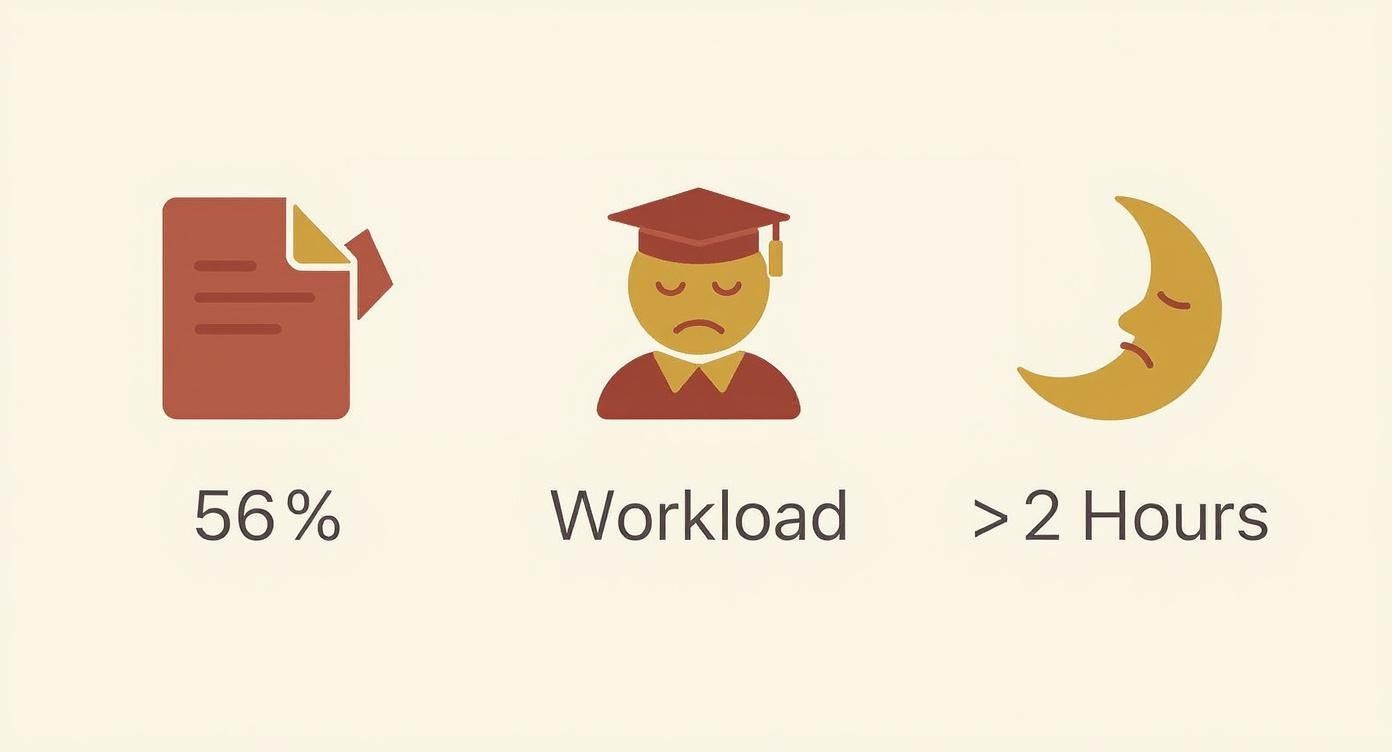
The data doesn't lie. When homework feels irrelevant or just takes up too much of your time, your ability to concentrate takes a nosedive.
Internal and External Barriers
On top of the outside noise and heavy workloads, what's going on inside your head plays a huge role. Certain conditions that mess with executive functions can make it incredibly tough to just get started and stay on task.
For anyone needing some extra support in that area, our guide on how to focus with ADHD offers some targeted strategies. Once you understand these hurdles, you can start using practical solutions that actually work.
Building Your Distraction-Free Study Zone
Your environment is either your biggest asset or your worst enemy when it comes to homework. I always tell students to think of their study space like a gym—it needs to be designed for one specific purpose. When you consciously engineer a space that signals "it's focus time" to your brain, you're taking one of the most powerful steps toward better concentration.
This isn't just about tidying up. It’s about building a fortress against every possible distraction. And the research backs this up. A recent report found that schools using high-dosage tutoring—which absolutely depends on structured, supportive learning spaces—saw a massive 40 percent improvement in student concentration. If you want to dive deeper into how environment shapes focus, check out this in-depth analysis from EdWeek.
Taming Your Physical Space
Let’s start with your desk. If it’s covered in old papers, snack wrappers, and random junk, your brain is going to mirror that chaos. A clean, organized desk sends a clear signal: it’s time for serious work.
- Designate a Spot: This is non-negotiable. Use the exact same location every single time you study. That consistency trains your brain to automatically shift into focus mode the moment you sit down.
- Optimize Lighting: Bad lighting is a concentration killer. It causes eye strain and mental fatigue before you even get started. Position your desk to catch natural light if you can, and get a solid desk lamp for night sessions.
- Control the Noise: Some people need absolute silence, while others work better with a low hum. For total quiet, a good pair of noise-cancelling headphones creates an instant bubble of concentration. You can find the perfect pair on our website to block out everything from family chatter to the neighbor's dog.
A dedicated study zone isn’t a luxury; it’s a non-negotiable tool for deep work. By controlling what you see and hear, you reclaim cognitive resources that would otherwise be wasted on fighting distractions.
Fortifying Your Digital World
Okay, your physical space is handled. But that's only half the battle. Digital distractions are way more seductive and are literally designed to pull you away from what you're doing. The good news? You can fight tech with tech.
Your phone is the number one focus killer. Get it out of sight and out of mind. Put it in another room, silenced. Just removing it from your immediate area demolishes the constant temptation to check notifications. If you need your computer, install tools that turn it into a digital fortress.
- Freedom: This app is a game-changer. It blocks distracting websites and apps across all your devices.
- Forest: A clever app that gamifies focus. You plant a virtual tree that grows as you work. If you leave the app to get distracted, the tree withers and dies.
- StayFocusd: This is a Chrome extension that lets you limit the amount of time you can waste on specific websites.
When you combine a clean physical setup with a locked-down digital one, you create an environment where focus is the default setting. It's a foundational step for hitting that deep level of concentration needed for real learning, and it's how you start getting into a state of "flow." You can learn more about this incredibly powerful mental state in our guide on how to achieve flow.
Your Distraction-Free Study Zone Checklist
Use this checklist to create a physical and digital environment that promotes deep focus and minimizes interruptions.
| Element | Action Item | Why It Works |
|---|---|---|
| Desk | Keep it clean, organized, and free of clutter. | A clean space reduces cognitive load and signals "work time" to your brain. |
| Location | Study in the same dedicated spot every single time. | Builds a powerful psychological trigger that helps you get into focus mode faster. |
| Lighting | Use a mix of natural light and a good desk lamp. | Prevents eye strain and mental fatigue, which are major concentration killers. |
| Noise | Use noise-cancelling headphones or find a quiet space. | Eliminates auditory distractions so your brain can concentrate on one thing. |
| Phone | Place it in another room, silenced, and out of sight. | Removes the biggest and most tempting source of digital interruptions. |
| Computer | Install a website/app blocker like Freedom or StayFocusd. | Creates a digital fortress, making it impossible to mindlessly browse social media. |
Building this "focus fortress" is a one-time setup that pays dividends every single time you sit down to study. It's about making focus the path of least resistance.
Using Smart Techniques to Manage Your Time

Here’s the thing: it’s not about studying longer; it’s about studying smarter. The most successful students aren't the ones pulling caffeine-fueled all-nighters. They're the ones who master their own time, using proven systems to get more done in fewer, more focused hours.
This mindset shift is critical. Endless hours of grinding away at homework often lead to diminishing returns. In fact, some research suggests that after about four hours of homework per week, the extra time you put in provides almost no real academic benefit. Instead of brute force, you need a strategy.
The Pomodoro Technique for Intense Focus
The Pomodoro Technique is an absolute game-changer if you struggle with procrastination or feel overwhelmed by huge assignments. It’s deceptively simple but incredibly effective. You just break your work into short, timed intervals—traditionally 25 minutes—separated by quick breaks.
Let's walk through a real-world scenario. Say you have a five-page history essay staring you down.
- Set a timer for 25 minutes: For this window, you do nothing but work on that essay. No phone, no social media, just pure focus.
- Take a 5-minute break: When the timer dings, stop. Immediately. Stand up, stretch, grab some water, or just stare out the window. The key is to completely unplug from the task.
- Repeat the cycle: After four of these focused sessions (or "Pomodoros"), you earn a longer break of 15-30 minutes.
This method helps you bypass that initial mental block by slicing a massive project into bite-sized chunks. It also trains your brain to sustain intense concentration for short bursts, which is way more realistic than trying to stay locked in for hours on end.
Time Blocking to Plan Your Entire Evening
While the Pomodoro Technique is for managing individual tasks, Time Blocking is about structuring your entire schedule. You literally assign a specific "block" of time on your calendar for every single thing you need to do—including homework, meals, and even relaxation.
Imagine you have a tough set of math problems and a biology chapter to read. A time-blocked evening could look like this:
- 5:30 PM - 6:00 PM: Decompress from school (no screens!)
- 6:00 PM - 6:30 PM: Dinner
- 6:30 PM - 7:30 PM: Math Problems (with one Pomodoro break in the middle)
- 7:30 PM - 7:45 PM: Long Break (walk around, listen to music)
- 7:45 PM - 8:30 PM: Biology Reading
- 8:30 PM onwards: Free time
By giving every minute a job, you eliminate the guesswork and decision fatigue that so often lead to procrastination. You're not just hoping you’ll find time for homework; you're making time for it.
Combining these two techniques creates a powerful system for crushing your workload while still protecting your downtime. For a deeper dive, check out these Effective Time Management Strategies for Students.
Ultimately, these strategies are about boosting your efficiency and focus—skills that will serve you long after you've left the classroom. If you're looking for more ways to sharpen your daily output, our guide on how to increase productivity at work offers some great insights that apply here, too.
Boosting Brainpower and Your Mindset

Fixing your environment and schedule is a huge win, but real, unbreakable concentration is an inside job. What’s going on in your head ultimately decides whether you can truly lock in or just go through the motions. Getting your mindset right is just as important as shutting out distractions.
The mental game starts with how you frame the task itself. If you see homework as a boring chore, your brain will naturally put up a fight. It’s a defense mechanism against stuff we find tedious or stressful.
But you can flip the script. Try reframing that assignment from a "chore" into a "challenge" or a "puzzle." This simple cognitive shift fires up different parts of your brain, making the work feel more engaging and way less of a drag.
Strengthening Your Mental Muscle
Your ability to concentrate is like a muscle—it gets stronger the more you train it. One of the best ways to build this mental stamina is with simple mindfulness exercises. You don’t need to meditate for hours on a mountaintop; even a few minutes can make a world of difference.
Before you start a study session, give this a shot:
- Sit somewhere comfortable and close your eyes.
- Put all your focus on the feeling of your breath coming in and going out.
- When your mind wanders (and it absolutely will), just gently guide your attention back to your breath. No judgment.
This simple routine trains your brain to notice when it's off-task and pull itself back, which is the core skill for learning how to concentrate on homework. Doing this regularly builds up your attentional control, making it much easier to stay dialed in when distractions pop up later.
The goal isn't to have a totally empty mind. It's to learn how to manage the thoughts that come and go. By constantly returning your focus to one thing, you build the mental resilience you need for long stretches of deep work.
Supporting Your Brain's Performance
Beyond mental tricks, you can also support your brain’s raw performance with the right fuel. This is where nootropics—often called "cognitive enhancers"—come into play. These are compounds that can support key mental functions like memory, creativity, and most importantly for us, focus.
High-performers in every field use nootropics to get a clean mental edge during demanding tasks. They aren't magic pills, but they are a powerful tool when you combine them with the other strategies we've talked about. They work by supporting your brain’s natural chemistry.
For instance, our Dialed In Nootropics focus blend is carefully formulated to support mental clarity without the jitters you get from too much caffeine. Ingredients are chosen specifically to work together for smooth, sustained focus.
Two key ingredients you’ll often find in effective nootropic blends are L-Theanine and Bacopa Monnieri.
- L-Theanine: This is an amino acid usually found in green tea, and it’s incredible for promoting a state of calm alertness. It helps take the harsh "edge" off of stimulants like caffeine, giving you a smoother, more controlled focus.
- Bacopa Monnieri: A classic herb used for centuries to support brain function. Modern research suggests it can help with memory formation and information processing speed—super useful when you're trying to learn new material.
These compounds work by supporting the neurotransmitters involved in attention and cognitive processing. By giving your brain these building blocks, you create the optimal internal environment for concentration. You can dive deeper into our guide on the best supplements for concentration to see exactly how they support your mental game.
What to Do When You Feel Like Giving Up
Even with the perfect study space and a solid schedule, you’re going to have moments when your brain just says “no.” We’ve all been there. That urge to quit, procrastinate, or just stare into space is universal.
This isn't a sign of failure. Think of it as a signal from your brain that it’s time to switch things up.
When you feel that mental resistance building, don't try to power through it. Instead, try the 5-Minute Rule. Just promise yourself you’ll work on the task with total focus for five minutes. That’s it.
Starting is almost always the hardest part. Once you clear that initial hurdle, you’ll often find you’ve built enough momentum to keep going for much longer.
Using Breaks That Actually Recharge You
When you hit a wall, what’s your first instinct? For most of people, it's grabbing their phone and scrolling. This is one of the worst things you can do for your focus.
Research shows that this kind of “break” doesn’t let your brain rest at all. It just floods it with new, low-value information, leaving you feeling even more drained than before. A truly strategic break does the opposite—it gives your prefrontal cortex a chance to actually reset.
Here are a few that work:
- Move Your Body: A few quick stretches, some jumping jacks, or a short walk around the block is all it takes. Physical movement pumps more blood to your brain, boosting alertness almost instantly.
- Change Your Scenery: Just looking out a window at something natural—trees, clouds, anything—can help restore your directed attention.
- Do a 'Mind Dump': Grab a piece of paper and scribble down every distracting thought bouncing around in your head. Getting it all out clears up precious mental bandwidth.
These aren't escapes from your work; they’re investments in your productivity.
The Power of Rewards and Refueling
Sometimes, all you need is a little external motivation to get you over the hump. Set up a simple reward for yourself: "After I finish this chapter, I can watch one episode of my show." This creates a clear finish line and gives your brain a concrete reason to push forward.
A well-structured reward system isn't about bribing yourself. It's about leveraging your brain's natural dopamine response. You're creating positive feedback loops that make the hard work feel genuinely more satisfying.
This is also where fundamentals like sleep and nutrition become your secret weapons. You can't expect a tired, undernourished brain to concentrate. Prioritizing 8-10 hours of sleep and having brain-friendly snacks on hand (like nuts, berries, or dark chocolate) gives you the biological foundation you need for tough mental work.
If you’re looking for more ways to keep your internal drive high, our guide on how to increase dopamine naturally offers more practical tips.
Common Questions About Homework and Focus

Even when you have a solid game plan, you're bound to run into specific roadblocks while figuring out how to concentrate on homework. Let’s tackle some of the most common questions students have with some quick, no-nonsense answers.
How Long Should I Study in One Sitting?
Grinding away for hours is the fastest path to burnout, not better grades. You’ll get way more done by working in short, intense bursts when your focus is at its absolute peak.
Try aiming for focused sessions of 25 to 50 minutes, then take a real break for 5 to 10 minutes. This rhythm, often called the Pomodoro Technique, stops your brain from getting fried and keeps you feeling fresh. Each study block actually ends up being more effective than the last.
Does Listening to Music Actually Help?
For a lot of people, the answer is yes—but the type of music you choose is everything. The real goal is to find something that blocks out distracting background chatter without becoming a distraction itself.
- Good choices: Think instrumental tracks, lo-fi beats, classical music, or even ambient sounds like rain. These create a focused vibe.
- What to avoid: Anything with lyrics is usually a bad idea. Your brain will instinctively try to follow the words, which pulls your attention right off your homework.
Ultimately, there's no magic playlist. You have to experiment. Try different genres, or even just silence, to figure out what truly helps you lock in and get into that deep work zone.
What if My Homework Is Just Boring?
We’ve all been there. When an assignment is painfully dull, your motivation flatlines. Don't just let it sit there looming over you—hit it with this simple three-part attack.
First, just get it over with. It’s a classic productivity trick called "Eat the Frog," where you tackle your most dreaded task first. Once it's done, everything else on your list feels like a breeze.
Next, connect it to a bigger goal. Remind yourself that finishing this one boring assignment is a step toward passing the class.
Finally, set up a real reward. Promise yourself something you actually want—like an hour of gaming or watching your favorite show—but only after the task is 100% complete.
Are Focus Supplements Safe for Students?
When you buy from a reputable company, most nootropics are made with well-researched, natural ingredients that support cognitive functions like memory and focus. The key is to look for brands that are transparent about what’s in their products and to always follow the recommended dosage.
Our Dialed In Nootropics are formulated with high-quality ingredients to support exactly that kind of mental clarity. As with any supplement, it’s always a good idea to chat with a healthcare professional first.
Ready to give your brain the support it needs to stay locked in? FocusPouches.com offers scientifically formulated nootropic gum and pouches designed for clean mental clarity and crash-free alertness. See the difference for yourself and shop our full collection today.