

Want to improve your cognitive flexibility? Start small. Consciously break a tiny daily routine—take a new route to work, brush your teeth with your non-dominant hand, or try a completely different workout.
This simple act forces your brain to carve out new pathways, which is the foundational step toward becoming more mentally agile and adaptable to whatever life throws your way.
What Cognitive Flexibility Really Means for You

Let’s cut through the jargon. At its core, cognitive flexibility is your mind’s ability to adapt, switch gears, and see problems from new angles. It’s the mental skill that allows you to pivot gracefully when you get hit with a curveball.
Think of a project manager who instantly adjusts a timeline when the budget gets slashed. Or a parent who finds a creative, visual way to explain a math problem when the textbook method isn’t clicking for their kid. That's cognitive flexibility in action.
It's not just about being "open-minded"—it's an active process of mental adaptation.
The Real-World Impact of an Adaptable Mind
An agile mind is a resilient one. When you can easily shift your perspective, you're just better equipped to handle stress and unexpected setbacks. Instead of getting stuck in rigid, circular thinking, you can generate alternative solutions and move forward.
This skill is a game-changer in both your personal and professional life. Here’s a quick rundown of why it matters so much:
- Smarter Problem-Solving: It helps you break down complex issues and find clever solutions that others might completely miss.
- More Creativity and Innovation: By connecting seemingly unrelated ideas, you can generate fresh, original thoughts.
- Better Emotional Resilience: You're far less likely to get derailed by frustration when a plan doesn't work out.
A flexible mind doesn't see a roadblock; it sees a detour. This mental agility is the foundation for overcoming obstacles, reducing stress, and unlocking creative potential in everyday life.
Why You Can Actively Improve This Skill
Your brain isn't static. It's constantly forming and reinforcing neural connections based on your actions and thoughts—a concept known as neuroplasticity. When you intentionally introduce novelty and challenge into your routine, you are quite literally building a more flexible brain.
And the research backs this up. There's a strong link between cognitive flexibility and performance under pressure.
For instance, a study on medical students found a significant relationship between higher cognitive flexibility and better performance in challenging research environments. Those who were more mentally agile perceived fewer barriers, like time constraints or follow-up difficulties, allowing them to navigate obstacles more effectively. This shows that improving cognitive flexibility isn't just a "nice to have"—it's a critical tool for success. You can read the full research about overcoming professional challenges to see the data for yourself.
To better illustrate how this plays out in real life, let's look at the difference between stuck thinking and adaptable thinking across a few key areas.
Cognitive Flexibility in Action Key Areas of Impact
This table shows the real-world difference between rigid and flexible thinking, highlighting the tangible benefits of this essential skill.
| Life Domain | Low Cognitive Flexibility (Stuck Thinking) | High Cognitive Flexibility (Adaptable Thinking) |
|---|---|---|
| Career | "This is how we've always done it." Resists new processes and tools, gets frustrated by change. | "Let's test this new approach." Sees change as an opportunity for improvement and growth. |
| Relationships | Struggles to see the other person's point of view during a disagreement, leading to conflict. | Can understand and consider different perspectives, making it easier to find a compromise. |
| Problem-Solving | Tries the same failed solution repeatedly, feeling stuck and overwhelmed. | If the first idea doesn't work, easily pivots to try a different strategy. Sees setbacks as learning experiences. |
| Personal Growth | Avoids new hobbies or experiences because of a fear of failure or discomfort with the unfamiliar. | Eager to learn new skills, try new things, and step outside their comfort zone. |
| Stress Management | A minor disruption (like a traffic jam) can ruin the entire day. Gets fixated on the negative. | Acknowledges the disruption, quickly re-plans, and moves on without letting it derail their mood. |
As you can see, the ability to pivot isn't just about big life changes; it's about navigating the small, everyday challenges with more ease and less friction.
Train Your Brain with Structured Mental Workouts

Boosting cognitive flexibility isn’t some abstract goal—it’s a skill you can build with targeted practice. Forget about aimless brain games. Think of these exercises as a dedicated gym session for your mind, designed to build mental agility and pull you out of rigid thinking patterns.
These workouts force your brain to ditch its default pathways and forge new connections. Just like lifting weights strengthens muscles, these drills strengthen your ability to adapt and pivot on demand.
Exercises to Break Mental Habits
The trick is to introduce challenges that specifically target your brain's ability to shift perspectives. You can start with simple but powerful exercises that don’t require any special equipment.
One of the most effective is the "Unusual Uses Test." Grab a common object—a brick, a paperclip, a coffee mug. Set a two-minute timer and brainstorm as many alternative uses as you can, pushing past the obvious. A brick isn't just for building; it's a doorstop, a bookend, a paperweight, or even a makeshift weight for exercises.
This simple activity forces you to look past your initial assumptions and fire up your creative problem-solving circuits. It's a direct workout for flexible thinking.
Another powerful technique is rapid task-switching. This exercise intentionally creates cognitive friction by making you shift rules on the fly.
- Card Sorting Challenge: Grab a standard deck of cards. First, sort the entire deck by suit (hearts, diamonds, clubs, spades). The moment you finish, immediately re-sort the same deck by number (aces, twos, threes, etc.). Finally, sort it again by color (red and black).
Each switch forces your brain to inhibit the old rule set and load a new one. You're directly training the mental muscles responsible for flexibility. For a deeper dive into targeted mental conditioning, improving chess calculation with focused drills can also give your processing speed and accuracy a serious boost.
The Science Behind Task-Switching
So, why does forcing yourself to switch tasks work so well? It’s because you’re actively practicing the core components of cognitive flexibility—shutting down an old response and firing up a new one.
Research shows that structured cognitive training focused on task-switching can significantly improve cognitive flexibility. Studies demonstrate that this kind of training leads to better switching performance and enhances neural efficiency related to how the brain monitors conflict.
This means you’re not just getting better at the card game; you’re rewiring your brain to be more adaptable in all areas of life. Long-term studies have found that participants who regularly train with task-switching exercises show clear behavioral improvements and corresponding neural changes that point to a more efficient brain.
These mental workouts demand intense concentration. If you find your mind wandering, you might want to check out our guide on how to focus while studying for tips on maintaining that mental clarity. At the end of the day, consistent practice is what gets you lasting results.
Build a More Flexible Mind with Daily Habits
Your environment and daily routines have a massive impact on your mental agility. But here's the good news: improving cognitive flexibility doesn't require a total life overhaul. Small, consistent tweaks can build a more adaptable mindset without adding hours to your already packed day.
The secret is to consciously introduce novelty. Your brain loves new stimuli—it’s what pulls it out of rigid, autopilot patterns. Think of it as creating small, intentional disruptions to your normal flow.
This could be as simple as trying a new spot for lunch instead of hitting your usual go-to. Or, you could switch up your music for the day. If you're always listening to rock, throw on some classical or jazz. Even spending ten minutes learning a few phrases in a new language online gives your brain a fresh challenge.
Embrace Physical and Mental Coordination
Physical activity isn't just for your body; it's a powerful tool for your brain. Activities that force you to combine physical coordination with quick thinking are especially good for building mental agility.
Think about sports like dancing, tennis, or even martial arts. These activities force you to constantly adapt your movements in response to something new—a partner's step, an opponent's serve, or the next move in a sequence.
This kind of dynamic engagement strengthens the neural pathways responsible for rapid decision-making and adaptive thinking. You're not just working your muscles; you're training your brain to pivot and respond on the fly.
Research shows that mind-body exercises like yoga or tai chi are particularly effective for improving cognitive flexibility. A systematic review found that sessions lasting 46–60 minutes, 5-7 days a week, significantly boosted this skill in adults.
Even small actions make a big difference. Building simple, effective routines can have a huge impact on your brain's ability to adapt. You can learn more about establishing consistent daily health habits to see how these small changes add up over time.
Cultivate Mindful Awareness
One of the biggest roadblocks to flexibility is getting stuck in a thought loop without even realizing it. This is where mindfulness comes in. It’s simply the practice of paying attention to your thoughts and feelings in the moment, without judgment.
Mindfulness helps you become an observer of your own mind. By practicing it, you can start to notice when you're fixated on a problem or falling back on a default emotional reaction. That awareness is the critical first step to consciously choosing a different response.
Here are a few ways to get started:
- The 5-Minute Check-In: Once a day, just pause and notice what your thoughts are doing. Are they productive? Are you replaying a conversation? Just acknowledging the pattern is half the battle.
- Mindful Walking: On your next walk, put all your attention on the feeling of your feet hitting the ground, the sounds around you, and the air on your skin. This pulls you out of your head and into the present.
This practice is a direct counter to stress, which is known to crush cognitive flexibility. When you're less stressed, your mind is clearer and more open to new ideas. This mental state also supports healthy neurotransmitter levels. For more on that, check out our guide on how to increase dopamine naturally, a key player in motivation and mental reward.
Stay Agile in High-Pressure Situations
Cognitive flexibility shines brightest when the stakes are high and the pressure is on. Under stress, our brains often default to rigid, black-and-white thinking—the exact opposite of what’s needed to navigate a crisis. Learning how to stay mentally agile in these moments is a critical skill for clear-headed decision-making.
Think about an entrepreneur whose main supplier suddenly goes out of business. The rigid thinker panics, seeing only the immediate disaster. But the flexible thinker deploys a mental model like problem reframing. They actively shift their perspective to view this setback as an unexpected opportunity to find a better, more affordable supplier they wouldn't have looked for otherwise.
This isn't about ignoring the problem; it's about consciously choosing how you frame it.
Practical Frameworks for On-the-Spot Agility
When you’re up against a deadline or staring down a critical error, you don’t have time for abstract exercises. You need battle-tested tactics that work right now. One of the most effective mental models is the "Three Alternatives" rule.
Before you commit to a course of action, force yourself to generate three distinct solutions to the problem at hand. This simple rule prevents you from getting locked onto the first idea that pops into your head, which is often a reactive, stress-driven one.
For a developer debugging a critical error, the alternatives could be:
- Revert to the last stable version immediately.
- Isolate the problematic module and deploy a temporary hotfix.
- Consult a senior developer for a second opinion before acting.
This method forces a moment of deliberate thought, breaking the cycle of panic and expanding your field of options. It's a structured way to ensure you're making an adaptive choice, not a desperate one. When you can enter a state of deep focus, generating these options becomes even easier. You can explore techniques in our article on how to achieve flow to get into that productive headspace.
Control and Alternatives: The Keys to Performance
The ability to generate alternatives and maintain cognitive control is a powerful combination, especially in high-stakes environments. This isn't just theory; it’s backed by performance data.
An empirical investigation into athletes' decision-making found that cognitive flexibility accounted for 18.1% of the variance in their effectiveness. The key factors were their ability to generate diverse strategies ('Alternatives') and maintain control over their thought processes ('Control').
Athletes who excel at this make faster, better decisions under pressure. This same principle applies whether you’re in a boardroom, a hospital, or a workshop. To learn more about these findings, you can discover more insights about decision-making in sports on the Journal of Mental Health. This shows that training your brain to generate options isn't just a mental trick—it’s a direct pathway to better outcomes when it matters most.
Supplements That Support Mental Agility
Mental exercises and new habits are great for building a more flexible mind, but targeted nutrition gives your brain the biochemical fuel it needs to actually rewire itself. Think of certain supplements and nootropics as the raw materials that support the neural pathways essential for cognitive flexibility. They give your brain what it needs to adapt and perform under pressure.
These aren't magic pills, but when used correctly, they can be powerful allies. They work by enhancing neurotransmitter function, buffering the brain against stress, and promoting overall neurological health—all of which are critical for becoming more mentally agile.
Ultimately, the goal is to create a simple, repeatable process for agile thinking.
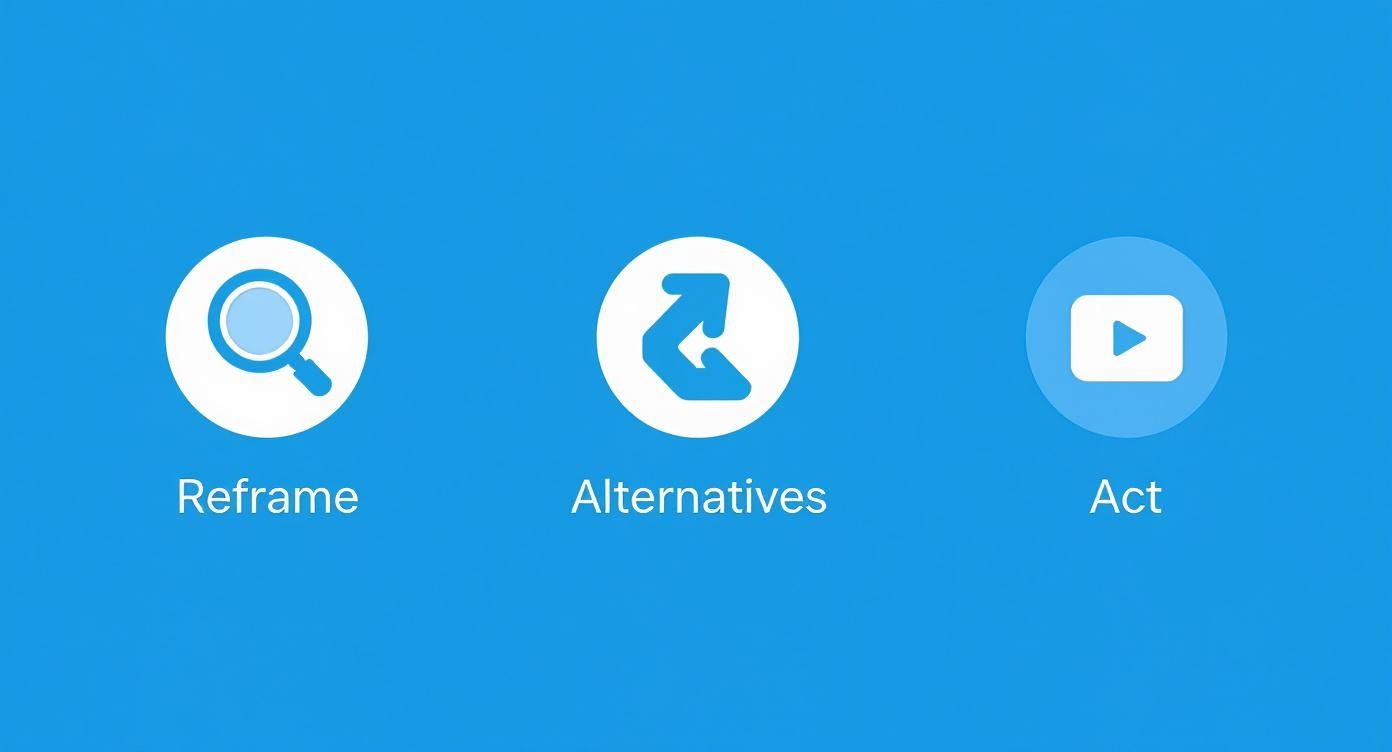
This breaks it down into three core actions: reframing your perspective, generating alternatives, and then taking decisive action based on this new information.
Key Nootropics for a More Adaptable Brain
Several well-researched compounds can directly support the brain's adaptive processes. By targeting different aspects of cognitive function, they create a synergistic effect that helps you build a more resilient and flexible mindset.
Here are a few standouts:
-
Bacopa Monnieri: This adaptogenic herb has been a staple in Ayurvedic medicine for centuries, known for boosting memory and information processing speed. It works by supporting the growth of dendrites (nerve endings), which improves communication between brain cells. Better cell-to-cell communication is fundamental for learning new things and adapting on the fly. You can purchase our Bacopa Monnieri blend to experience these benefits directly.
-
Rhodiola Rosea: A powerhouse adaptogen, Rhodiola is prized for its ability to increase resilience to both physical and mental stress. When you're stressed, your thinking becomes rigid and cognitive flexibility plummets. Rhodiola helps regulate cortisol levels, preventing the mental shutdown that often comes with high-pressure situations. Find this adaptogen in our Rhodiola Rosea formula.
-
L-Theanine: Commonly found in green tea, L-Theanine is famous for promoting a state of calm, alert focus. It increases alpha brain waves, which are associated with relaxed attentiveness. This mental state makes it far easier to shift perspectives without the jittery anxiety that can lock you into a single, unproductive train of thought. Our L-Theanine pouches are designed to deliver this calm focus.
Key Takeaway: Targeted supplementation provides the building blocks for neurological health. This makes it easier for your brain to form new connections and break old, rigid thought patterns. For anyone serious about improving cognitive flexibility, this biochemical support is a crucial piece of the puzzle.
Nootropics for Cognitive Flexibility: A Quick Guide
To help you choose the right support, this table breaks down some of the most effective nootropics for mental agility, what they do, and where to find them.
| Nootropic/Supplement | Primary Benefit for Flexibility | Mechanism of Action | Purchase Link |
|---|---|---|---|
| Bacopa Monnieri | Enhances memory & processing speed | Supports growth of nerve endings (dendrites) to improve neural communication. | Shop Bacopa Blend |
| Rhodiola Rosea | Increases resilience to stress | Helps regulate cortisol levels, preventing stress-induced mental rigidity. | Shop Rhodiola Blend |
| L-Theanine | Promotes calm, alert focus | Increases alpha brain waves, allowing for perspective shifts without anxiety. | Shop L-Theanine Formula |
These supplements offer a strategic way to bolster your brain's natural ability to adapt. For a more complete overview, you can explore our detailed guide on the best supplements for mental clarity to see how different compounds can work together.
Choosing the right stack can make a noticeable difference in your ability to think on your feet and navigate life’s complexities with greater ease.
Your Cognitive Flexibility Action Plan
So, how do we put all this theory into practice? Building cognitive flexibility isn't about some massive, life-altering overhaul. It’s about weaving small, potent habits into your everyday routine.
The goal here is to create a sustainable roadmap for a more agile and resilient mind. This isn't just an idea; it's a practical framework that layers mental exercises, small lifestyle tweaks, and smart supplement reminders into your week. Consistency is what really trains your brain to become more adaptable.
A Sample Weekly Template
To make this feel less abstract, here’s a simple structure you can borrow and make your own. The real secret is to mix up different activities to keep your brain guessing and growing.
- Mindful Mornings (Daily): Kick off each day with a quick five-minute mental check-in. Just notice your thoughts without judging them. This builds the self-awareness you need to spot rigid thinking before it takes hold.
- Mental Drills (3x a week): Set aside a few short sessions for exercises like the "Unusual Uses Test" or even simple card sorting games. Think of these as direct workouts for your brain's adaptive muscles.
- Novelty Injection (2x a week): Deliberately break your routine. It could be as simple as listening to a podcast you'd normally skip, trying a new recipe for dinner, or taking a different route on your daily walk.
- Supplement Support (Daily): Back up your mental training with the right fuel. Finding the best nootropics for focus can give your brain the biochemical foundation it needs for peak mental agility.
One of the easiest ways I've found to track progress is with a simple journal. At the end of the day, just jot down one moment where you successfully shifted your perspective or tackled a problem in a new way. Acknowledging these small wins makes the habit stick.
Your Questions, Answered
Even with the best game plan, you're going to have questions as you start rewiring your brain for more flexibility. Here are some quick, no-nonsense answers to the ones we hear most.
How Fast Will I Actually See Results?
There's no magic number here. The timeline really depends on how consistent you are and which exercises you’re putting in the work on.
That said, a lot of people notice a subtle but real shift within a few weeks. You might start catching yourself in a rigid thought pattern and consciously steer away from it. That's the first win.
Bigger, more noticeable changes—like a real boost in your problem-solving skills or feeling less stressed when plans go sideways—usually build up over several months. The name of the game is consistency, not perfection.
What's the Single Best Exercise to Start With?
If you're just dipping your toes in, the "Unusual Uses Test" is the perfect place to start. It’s dead simple, requires zero equipment, and immediately forces your brain out of its lazy, default pathways.
Just grab a common object—a paperclip, a coffee mug, whatever—and set a timer for two minutes. Your goal is to list as many creative, non-obvious uses for it as you can. It’s a low-stakes, high-impact drill for building mental agility from day one.
The biggest hurdle is just starting. Seriously, don't overthink it. Pick one small thing—the Unusual Uses Test or even a five-minute mindfulness check-in—and just commit to doing it for a week. Small, consistent moves are what create the momentum for massive change.
Ready to give your brain the fuel it needs for peak mental performance? Dialed In Nootropics offers scientifically formulated focus pouches and energy gum to sharpen your mental clarity and agility. Get a clean, crash-free, focused buzz with blends designed for people who demand more from their minds. Explore our collection and find your focus at focuspouches.com.


