

How to Improve Focus Naturally: how to improve focus naturally tips
That constant buzz of notifications isn't just a minor annoyance. It's actively draining your time, wrecking your productivity, and clouding your thoughts. This guide is your roadmap back to clarity, filled with practical, science-backed strategies to help you reclaim your attention and build a system for deep, sustained focus.
The Real Cost of Lost Attention and How to Reclaim It
In a world buzzing with alerts, the ability to truly concentrate has become a superpower. Those constant interruptions aren't just frustrating—they come with a real cost that hits everything from your work performance to your mental health. This isn't a failure of willpower; it's a battle against an environment designed to shatter our attention.

The numbers are staggering. The average knowledge worker in the US loses about 127 hours a year just to distractions. That's over three full workweeks spent trying to get back on track. This lost productivity adds up to huge economic losses, proving just how valuable uninterrupted focus really is.
Understanding the Brain's Battle for Focus
Your brain is hardwired to notice new things. It's a survival mechanism. That’s why a single notification can instantly pull you out of a complex task.
Every time you switch gears, your brain pays a price called "attention residue." Thoughts from the last thing you were doing linger, making it harder to dive deep into the new task. It’s this mental fog that prevents the high-quality, flow-state work we’re all chasing.
Improving your focus isn't about brute force. It's about creating the right conditions for your brain to do its best work by addressing both your internal state and your external environment.
The key is to stop fighting your brain’s natural tendencies and start working with them. When you understand how your mind operates, you can build a system that supports concentration instead of sabotaging it.
A Path to Reclaiming Your Attention
This guide offers a clear path forward, moving beyond quick fixes to build habits that actually last. We’ll explore evidence-based methods to help you regain control, including:
- Optimizing your physical and digital spaces to create a sanctuary for deep work.
- Fueling your body and mind with the right nutrients and hydration for peak cognitive performance.
- Building daily routines and rituals that prime your brain for concentration and prevent burnout.
We’ll also touch on how targeted, high-quality supplements can support these lifestyle changes. For a deeper look at that, check out our guide on boosting your energy and focus naturally. By combining these strategies, you can build a powerful system for achieving the mental clarity you need to tackle any challenge.
Design Your Environment for Uninterrupted Deep Work
Your surroundings are constantly sending subtle signals to your brain, either pulling you toward distraction or pushing you into concentration. To really improve your focus, you have to become the architect of your own space. This is about more than just tidying up; it's about building a "focus fortress" that shields your attention from every physical and digital interruption trying to break through.

Think of your workspace like a pilot's cockpit. Every essential control is within reach, logically organized, and all the non-essential noise is filtered out. Your desk and computer should work the same way, removing any friction between you and the task at hand.
Crafting Your Physical Focus Fortress
The first line of defense is managing what you see and hear. Even a low hum from an appliance or a messy pile of papers can slowly drain your cognitive resources. Your brain has to actively work to ignore that stuff, leaving you with less mental energy for what actually matters.
A cluttered desk is a minefield of broken focus. That stack of mail, old gadgets, or even a few photos can trigger a completely unrelated thought and yank you out of the zone. The goal is to make your workspace so dialed in that the only interesting thing to do is the task you set out to complete. If you're in an office, finding effective strategies for better focus through office cubicle privacy can be a game-changer.
Here’s how to start building your fortress:
- Control the Soundscape: Noise-canceling headphones are your best friend. If not, try playing ambient sounds like white noise or rain. The consistency masks unpredictable, jarring sounds that are guaranteed to break your flow.
- Optimize Your Lighting: Get natural light if you can—it’s brilliant for regulating your internal clock and boosting alertness. If you're stuck in a darker space, grab a lamp that mimics daylight to avoid the fatigue and eye strain that harsh office lighting causes.
- Implement a "Clear to Neutral" Policy: At the end of each day, spend just five minutes clearing your desk completely. This simple habit ensures you start tomorrow fresh, without the mental baggage of yesterday’s clutter.
Conquering Digital Distractions
Let's be honest: your digital environment is probably the bigger threat. Notifications, a sea of open tabs, and the siren song of social media create a constant state of distraction that makes real, deep work feel impossible.
This is where you have to get ruthless. It's time to establish some digital "no-fly zones." This isn't about willpower; it's about removing the temptation before it even has a chance.
Every notification is a tiny, unscheduled interruption that forces a context switch. Even if you ignore it, your brain has already registered and processed it, leaving behind what scientists call 'attention residue'—a lingering cognitive fog from the previous distraction.
You need to build a system that defaults to focus. Use app and website blockers to create protected blocks of time where you cannot access your biggest time-wasters. Get in the habit of closing all browser tabs that aren't directly related to your current task. Each open tab is like an unfinished to-do list item silently eating away at your mental RAM.
For more on building these powerful habits, our article on how to increase productivity at work offers some great next steps.
By intentionally designing your physical and digital worlds, you’re doing more than just removing distractions. You're creating powerful psychological cues that tell your brain, "It's time to concentrate." Suddenly, deep work becomes the path of least resistance.
Why Strategic Breaks Are a Productivity Superpower
The idea that you can power through hours of work without stopping is a complete myth. Not only is it a fast track to burnout, but it actively sabotages your ability to stay sharp.
True productivity isn't a grueling marathon. It’s a series of well-paced, intentional sprints followed by genuine recovery. Strategic breaks aren't a sign of weakness—they're your single greatest tool for sustaining high-level performance.
Many people think focus is a finite resource, like gas in a tank. But the reality is far more nuanced. Your brain doesn't just get tired; it gets bored. When you stare at one task for too long, your performance starts to dip, not because your mental energy is gone, but because your brain begins to tune out the unchanging signal.
Rethinking the Work-Break Cycle
To really nail your focus, you have to work with your brain's natural rhythms, not against them. Our minds operate in cycles of high and low energy, known as ultradian rhythms. Pushing past the 90-minute mark almost always leads to diminishing returns: brain fog, fatigue, and an open invitation for every distraction to come flooding in.
Instead of fighting this natural ebb and flow, lean into it. Structure your day into focused blocks of work punctuated by deliberate breaks. This keeps your brain fresh and prevents the mental fatigue that kills productivity.
A proven model for this is the 52/17 method. The concept is simple: work with intense, uninterrupted focus for 52 minutes, then take a complete 17-minute break. Researchers discovered this ratio by tracking the habits of the most productive employees, who instinctively separated their work into focused sprints and periods of total detachment.
What Makes a Break "Strategic"
Here's the key: the quality of your break is just as important as its timing. Mindlessly scrolling through social media or checking emails doesn't count. Those activities just keep your brain in a state of shallow, fragmented attention, robbing you of the mental reset you need to get back to deep work.
A truly strategic break involves "active recovery"—doing something that actually refreshes your cognitive resources.
Here are a few powerful examples:
- Get Moving: A short, brisk walk—especially outdoors—is fantastic. It increases blood flow to the brain, boosts alertness, and gives you a dose of natural light.
- Practice Mindfulness: Just a few minutes of deep breathing can calm your nervous system and clear out the mental clutter, making it way easier to refocus when you return.
- Engage a Different Sense: Listen to a song, step outside to feel the sun on your skin, or do a few simple stretches. Shifting your sensory input gives the cognitive parts of your brain a much-needed rest.
The goal of a break isn’t just to stop working. It's to create a mental state change that lets you return to your task with renewed energy and a fresh perspective.
This isn't just a hunch; it's backed by science. Our brains are wired to notice and respond to change. A study from the University of Illinois revealed that the performance drop we feel during long tasks is largely due to boredom, not just mental exhaustion. Participants who took brief, structured breaks maintained their focus far better than those who didn't. You can read more about how these diversions sustain attention and see how it applies to your own work.
By building structured breaks into your day, you create the novelty your brain craves. This simple shift helps you sustain a high level of concentration for longer, which means you get more done in less time. For those looking to master this state of effortless concentration, our guide on how to achieve a state of flow offers complementary techniques.
Ultimately, reframing breaks as a non-negotiable part of your workflow is one of the most powerful natural strategies for improving focus and hitting peak performance.
Fueling Your Brain for Lasting Cognitive Clarity
What you eat has a direct, profound impact on your ability to concentrate. Think of your brain as a high-performance engine—it needs premium fuel to run smoothly. Just like a car sputters on bad gas, your mind will struggle with brain fog and fatigue without the right nutritional support.
Lasting mental clarity isn’t about chasing a temporary sugar high or another cup of coffee. It’s about building a stable foundation of energy and giving your brain the raw materials it needs to build neurotransmitters—the chemical messengers that govern focus, mood, and memory. For anyone serious about improving focus, proper nutrition and hydration are non-negotiable.
Building Your Focus-Friendly Diet
The gut-brain connection is incredibly powerful. A diet heavy on processed foods, unhealthy fats, and refined sugars promotes inflammation, which is a known killer of cognitive function. On the flip side, a diet built on whole foods provides a steady stream of the nutrients your brain is constantly craving.
To start building a diet that supports focus, make these your priority:
- Omega-3 Fatty Acids: Found in fatty fish like salmon, walnuts, and flaxseeds, these fats are critical for building healthy brain cell membranes. They help reduce inflammation and support clear communication between neurons.
- Antioxidants: Berries, dark chocolate, and leafy greens are loaded with antioxidants that protect your brain from oxidative stress, a process that damages cells and contributes to cognitive decline.
- Complex Carbohydrates: Foods like oats, quinoa, and sweet potatoes provide a slow, sustained release of glucose—your brain's main fuel source. This prevents the sharp energy spikes and crashes from simple sugars that absolutely wreck your focus.
- Proper Hydration: Even mild dehydration can tank your concentration and memory. Sipping water consistently throughout the day keeps your cognitive machinery running without a hitch.
Of course, all the good food in the world won't help if you aren't sleeping. Restorative sleep is when your brain cleans house and consolidates memories. It’s essential to consider strategies for alleviating sleep disorders for better cognitive function.
The food you eat literally becomes the building blocks for your thoughts. Choosing nutrient-dense foods is one of the most direct ways to invest in your long-term mental performance.
This simple cycle of work and strategic rest is key. You can't just push through nonstop.
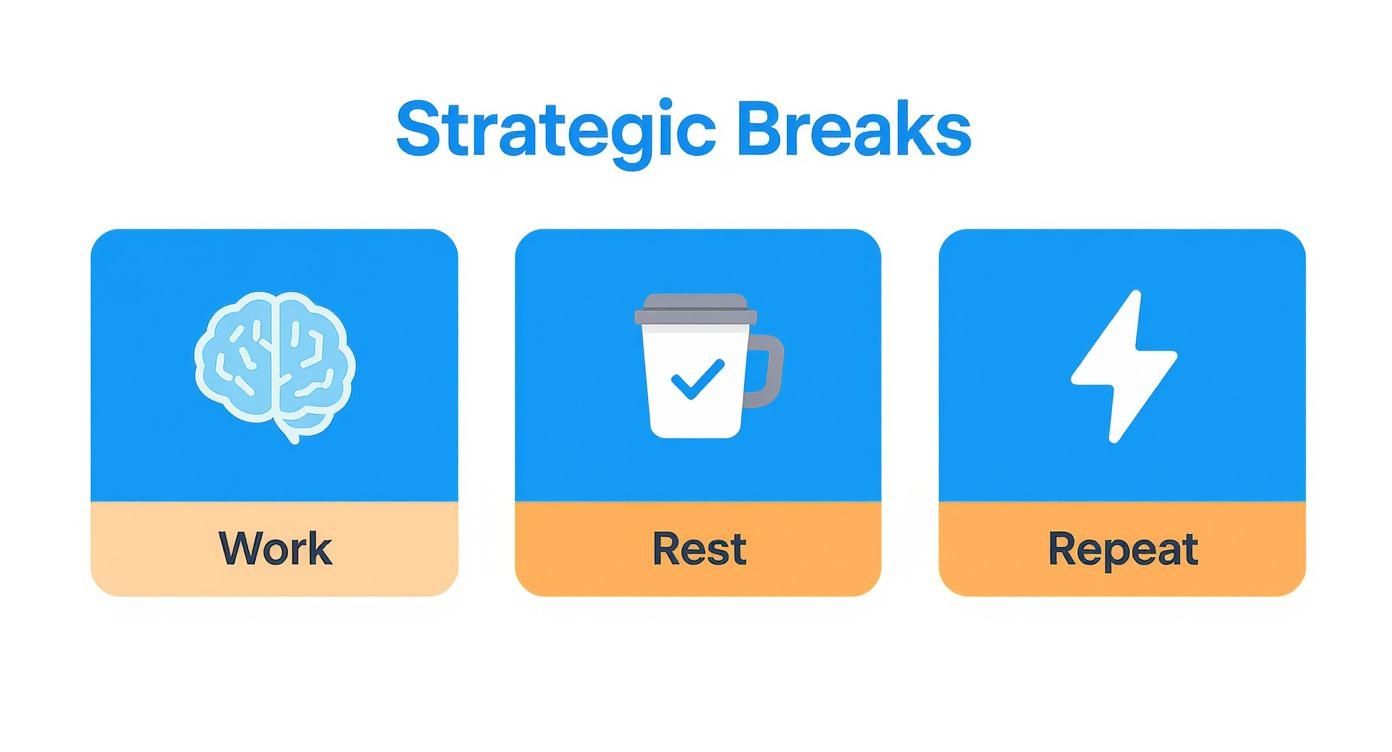
Productive work requires not just intense effort but also deliberate recovery to keep your mind sharp.
Demystifying Supplements for Enhanced Focus
Beyond diet, certain natural compounds can offer targeted support for cognitive function. These aren't magic pills. They are well-researched ingredients that work with your brain's natural chemistry to support focus, memory, and stress resilience. Understanding how they work is the key to choosing the right ones.
For those looking to add a reliable edge to their routine, nootropics can be a game-changer when sourced correctly. Below is a quick rundown of some of the most effective natural options.
Natural Supplements for Enhancing Focus
| Supplement | Primary Benefit | Mechanism of Action | Where to Find It |
|---|---|---|---|
| L-Theanine | Calm, alert focus | Increases alpha brain waves for relaxed concentration; boosts calming neurotransmitters (GABA, serotonin). | Green tea, high-quality nootropic formulas like our Nootropic Gum. |
| Bacopa Monnieri | Memory & Learning | Improves communication between brain cells; supports acetylcholine, a key neurotransmitter for memory. | Herbal extracts, Ayurvedic supplements. |
| Citicoline | Mental Energy & Clarity | Provides choline, a building block for acetylcholine and cell membranes, enhancing brain energy metabolism. | Found in premium nootropic blends like our Nootropic Pouches and standalone supplements. |
| N-Acetyl L-Tyrosine (NALT) | Focus Under Stress | A precursor to dopamine and norepinephrine, helping maintain cognitive function during demanding tasks. | Advanced focus formulas, often paired with other nootropics. |
When exploring nootropics, it's crucial to look past just the ingredient list. The quality, purity, and bioavailability of a supplement are what actually determine if it works.
Our Dialed In Nootropic Gum and Nootropic Pouches are formulated with synergistic ingredients like L-Theanine, Citicoline, and N-Acetyl L-Tyrosine to provide clean mental clarity without the crash. They offer a convenient, fast-acting way to support your focus exactly when you need it most.
For a deeper dive into choosing the right cognitive enhancers, check out our guide on the best supplements for mental clarity. By combining a brain-healthy diet with targeted, high-quality supplements, you create a powerful system for achieving sustained focus and peak mental performance.
Building Daily Rituals for Sustainable Focus
Improving your focus isn't about finding a magic bullet. It's about building a system of consistent, intentional habits. Theory is great, but the real change happens when you move from knowing what to do to actually doing it.
This is where daily rituals come in. They prime your brain for concentration and help it decompress, preventing burnout and turning focus into a sustainable skill you can rely on.
Think of these rituals as the warm-up and cool-down for your mind. Just like an athlete preps their body before a game, you need to prepare your brain before demanding intense focus from it. Structured routines are how you turn abstract goals into concrete actions.
Schedule and Protect Your Deep Work Blocks
The cornerstone of any focus-building routine is deep work—uninterrupted blocks of time dedicated to a single, high-value task. This isn't something you hope for; it's something you schedule and fiercely protect.
Start by identifying your most cognitively demanding tasks. Block out 60-90 minute sessions in your calendar specifically for them.
During these sessions, your only job is to eliminate every possible distraction. This means:
- Phone on silent and out of sight. Seriously, put it in another room. The mere presence of your phone can diminish your cognitive capacity.
- Notifications off. Close your email, mute Slack, and shut down any app that can send an alert.
- One task only. Resist the siren call of multitasking. Pour all your attention into the one thing you scheduled.
Treat these blocks like important meetings you cannot miss. This structure signals to your brain that it's time to enter a state of deep concentration, making focus the default rather than a struggle.
Leverage Social Accountability
One of the most powerful—and overlooked—natural focus enhancers is social accountability. It’s one thing to set a goal for yourself; it’s another to declare it to someone else. The simple act of sharing your intentions creates a psychological commitment that makes you far more likely to follow through.
In fact, one study found that sharing your intentions increased the chance of task completion to 65%. When you add a specific accountability appointment, that number jumps to an incredible 95%. This shows just how potent social accountability is for locking in your focus. You can find more surprising productivity statistics and insights on Flown.com.
This doesn't need to be complicated. A simple text to a friend saying, "I'm starting a 90-minute deep work session now to finish this report," can be enough to create the external pressure needed to keep you on track.
Practice Active Brain Training and Mindfulness
Your brain, like any muscle, gets stronger with targeted exercise. Integrating cognitive training and mindfulness into your daily routine can sharpen your ability to direct and sustain your attention over time.
One of the most effective techniques is Box Breathing. It’s a simple yet powerful practice used by high-performers to calm the nervous system and clear the mind before a demanding task.
- Inhale slowly through your nose for a count of four.
- Hold your breath for a count of four.
- Exhale slowly through your mouth for a count of four.
- Hold your breath at the end for a count of four.
- Repeat this cycle for 3-5 minutes.
This technique helps regulate your autonomic nervous system, pulling you out of a reactive, distracted state and into a calm, focused one. Journaling is another great tool for improving metacognition—or thinking about your thinking. A brief daily entry can help you spot distraction patterns and celebrate focus wins, reinforcing positive habits.
These rituals also support a healthy balance of key neurotransmitters. You can learn more about how to increase dopamine naturally in our detailed guide.
By creating pre-work rituals that prime your brain (like Box Breathing) and post-work rituals that help you decompress (like journaling), you build a robust framework for lasting focus. This turns the skill of concentration from an occasional victory into a reliable, everyday strength.
Your Questions on Natural Focus Improvement Answered
As you start putting these strategies into play, some practical questions are bound to pop up. Let’s get into the most common ones to make sure you’re set up for success.
How Long Does It Take to See Improvements in Focus?
This is a great question, and the honest answer is: it depends on the strategy. Some fixes give you an almost instant win, while others are more of a slow burn that builds over time.
You'll feel the difference from environmental tweaks right away. Seriously, just turning off your phone notifications or clearing your desk can cut through the mental clutter in minutes. The same goes for structured work blocks like the 52/17 method—you can feel sharper and more energized after the very first cycle.
On the other hand, things like diet, sleep, and supplements require more patience. You might start feeling more consistent energy and clearer thinking from nutritional changes within a few weeks. For specific nootropics, the effects often compound. For instance, studies on compounds like Bacopa Monnieri suggest it can take 8-12 weeks of daily use to see significant boosts in memory and focus.
The real key here is consistency. Think of it like going to the gym. One workout won’t transform your body, but sticking with it builds a powerful, resilient foundation for long-term focus.
Can I Combine These Techniques with Focus Supplements?
Absolutely. In fact, that's how you get the best results.
Think of the lifestyle habits we’ve covered—diet, mindfulness, environment, exercise—as building the foundation. They create the ideal conditions for your brain to operate at its peak.
Supplements then come in as targeted support. They deliver specific, high-quality compounds that can amplify the benefits you’re already getting from those solid habits.
Here’s how it works in practice:
- Diet + Omega-3s: A brain-healthy diet is great, but adding a quality Omega-3 supplement ensures you get an optimal, anti-inflammatory dose that’s hard to get from food alone.
- Mindfulness + L-Theanine: Pair a calming breathing exercise with L-Theanine, and you’ll create a powerful state of relaxed alertness that’s perfect for deep work.
- Deep Work Blocks + Nootropics: Taking a fast-acting nootropic like our Nootropic Gum or Pouches right before a planned focus session can give you the extra cognitive horsepower to stay locked in and crush your task.
My advice? Get the foundational habits dialed in first. Once you have that momentum, introducing high-quality supplements can sharpen your cognitive edge even further.
What Is the Single Most Important Change for Immediate Focus?
If you need one thing that will make a noticeable difference today, it’s this: aggressively control your digital environment. This is the lowest-hanging fruit with the biggest payoff.
Specifically, I’m talking about committing to single-tasking. For a set block of time—even just 50 minutes—turn off every non-essential notification on your phone and computer. Close every browser tab and app that isn't directly related to the one thing you’re working on.
This simple act directly fights back against the constant context-switching that absolutely demolishes our attention. Every ping, every new tab, every "quick" email check forces your brain to shift gears, leaving behind what scientists call "attention residue" that makes deep focus impossible.
By creating a temporary, distraction-free bubble, you give your brain the clean, uncluttered space it needs to enter a flow state. This one move can radically improve your productivity and mental clarity in a single afternoon, proving just how much control you really have over your ability to concentrate.
At Dialed In Nootropics, we're committed to providing the tools you need for peak mental performance. Our scientifically formulated Focus Gum and Nootropic Pouches deliver clean mental clarity and smooth, crash-free alertness to help you conquer your day. Explore our collection and find your focus at focuspouches.com.