

Improve reaction time: Quick Cognitive Drills and Training Tips
If you want to get faster, you first need to know how fast you are right now. Establishing a clear performance baseline is the only way to know if your training is actually working.
This means measuring your current speed and getting a handle on the different types of reactions your brain makes every day. A few simple online tests will give you a concrete number in milliseconds—your starting line. From there, you can start chipping away at it with targeted drills.
Establishing Your Performance Baseline
Before you can sharpen your reflexes, you need a clear picture of where you’re starting from. Reaction time isn't just a single reflex; it’s a whole sequence involving seeing something, processing it, and then making your body move.
Breaking this down is the first step toward real improvement, whether you're a gamer trying to nail a headshot or a trader executing a split-second decision. Those milliseconds matter everywhere. A surgeon, a pilot, a professional athlete—they all rely on the same lightning-fast neural pathways you're about to train.
The Different Types of Reaction Time
Your brain responds to the world in a few different ways. Knowing the difference helps you train smarter, not just harder.
- Simple Reaction Time: This is your raw speed. It’s how fast you react to a single, expected signal. Think of a sprinter launching off the blocks at the sound of the gun. One signal, one pre-planned action.
- Choice Reaction Time: This is where things get more complex and much more common in the real world. You’re faced with multiple signals, and each one requires a different response. A Call of Duty player deciding whether to shoot, duck, or reload based on what an opponent does is a perfect example.
- Recognition Reaction Time: This is about filtering out the noise. You’re shown several things at once but are told to only react to a specific one. It’s like a quality control inspector on an assembly line who has to spot and pull a single defective product from a stream of good ones.
Measuring Your Starting Point
Okay, time to get your number. You don't need a fancy lab for this. There are plenty of reliable online tools that can accurately test your simple visual reaction time. Run through a few tests to get a solid average score in milliseconds (ms).
This is your benchmark.
Here’s a quick look at what different reaction times mean in the grand scheme of things.
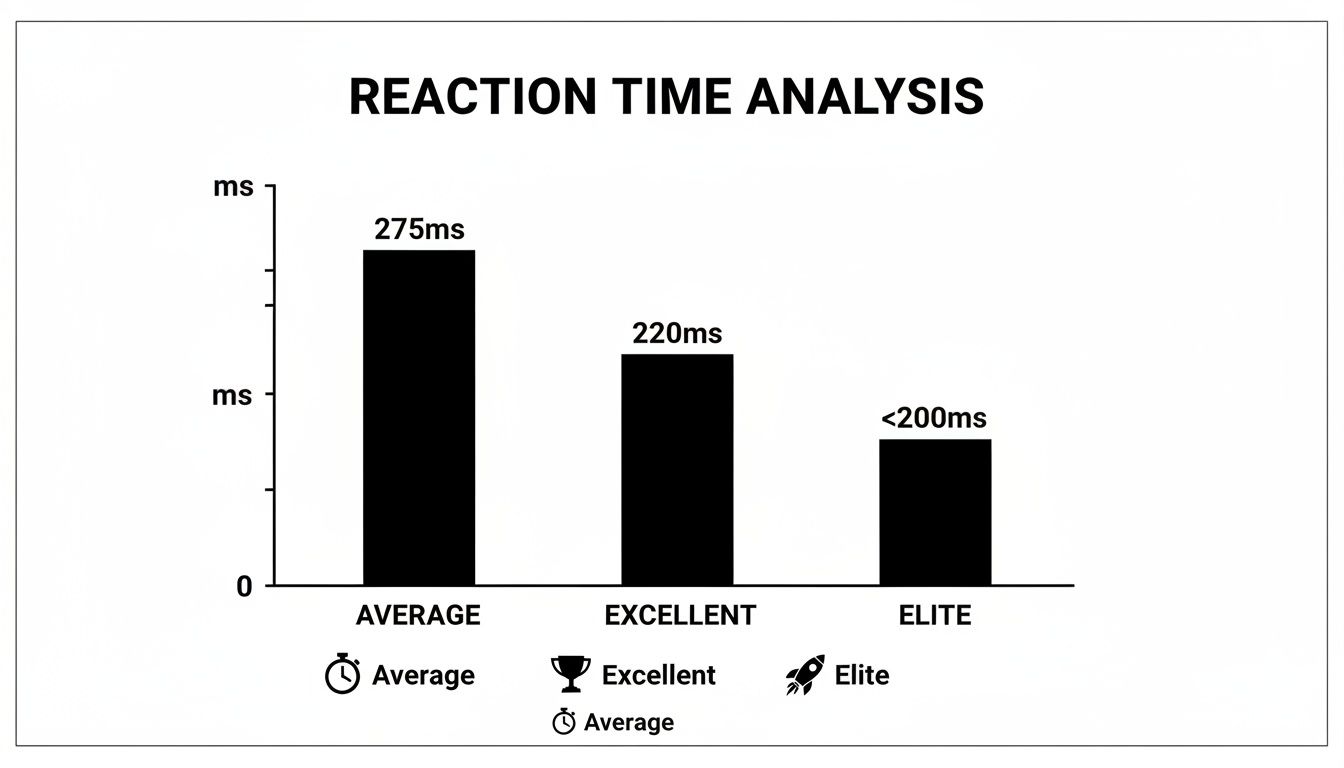
As you can see, an average reaction time hovers around 275ms. Excellent performers get closer to 220ms, while the truly elite can react in under 200ms.
Your initial score isn't just a number—it’s a powerful motivator. Seeing that number drop over the coming weeks is direct proof that your training is paying off, turning abstract effort into concrete results.
Of course, a lot of things can influence that baseline score. Let's break down some of the biggest factors that can either help or hinder your reaction speed.
Key Factors That Influence Your Reaction Time
| Factor | Impact on Reaction Time | Brief Explanation |
|---|---|---|
| Age | Slower with age | Studies show a gradual slowdown, averaging about 7 milliseconds per year after our mid-20s. |
| Sleep | Slower when fatigued | Lack of quality sleep significantly impairs cognitive processing and motor response. |
| Fitness | Faster with regular exercise | Physically active individuals generally have faster neural signaling and better motor control. |
| Nutrition & Hydration | Slower when deficient | Dehydration or lack of key brain nutrients can cause mental fog and delayed responses. |
| Caffeine/Stimulants | Can be faster (initially) | Moderate doses can increase alertness, but too much can lead to jitters and impaired fine motor skills. |
| Alcohol | Slower | Alcohol is a depressant that directly slows down central nervous system processing. |
| Mental State | Slower under stress/anxiety | High stress levels can overwhelm cognitive resources, making it harder to focus and react quickly. |
These factors highlight that your reaction time isn't set in stone; it's a dynamic metric influenced by your daily habits and overall health.
Age, for instance, has a massive impact. Data from the MindCrowd project revealed an average slowdown of 7 milliseconds per year. That means a quick 220ms at age 25 can easily become a sluggish 320ms by age 65. Other lifestyle choices matter, too—smokers, for example, tack on an extra 7ms to their reaction time on average.
Ultimately, your reaction time is a direct reflection of your cognitive efficiency. The speed and clarity of your thoughts dictate how quickly you can act. For a deeper dive into sharpening your mind, check out our guide on how to improve mental clarity. It’s the foundational skill that underpins every effort to get faster.
Cognitive Drills to Accelerate Processing Speed
To get seriously fast, you have to train the command center—your brain. While physical speed is a huge piece of the puzzle, the real bottleneck happens in the split-second between your eyes seeing something and your brain telling your body how to react.
The whole point of cognitive drills is to shrink that gap. Think of it as upgrading your brain’s firmware. These exercises make your neural pathways more efficient, reduce the mental load, and build the kind of resilience you need to perform under pressure. For a coder, that means spotting a bug in a line of code almost instantly. For a gamer, it's the micro-advantage that wins the match.
Sharpening Your Visual Processing
Your brain handles visual data incredibly fast, but there’s always room to get faster. Visual cue exercises are designed to train your brain to lock onto specific targets more quickly while filtering out all the distracting background noise.
You can find tons of online simulators built for this exact purpose. They flash different colors or shapes on the screen, and your job is to click only on the one you’re supposed to. It sounds simple, but it’s a direct workout for your recognition reaction time.
- Color Matching Drills: Find a tool that flashes different colored boxes and challenges you to click a specific color. Start slow, get your accuracy down, and then crank up the speed.
- Shape Recognition: This is the next level up from color matching. Instead of colors, you’re identifying a specific shape (like a circle) mixed in with others (like squares).
- Peripheral Vision Training: The really good drills place targets at the edges of your screen. This forces you to expand your field of awareness and react to things you aren’t even directly looking at.
Training Your Auditory Response
Let’s be real—in a lot of situations, the first cue you get isn’t visual. It’s the starting pistol in a race or a callout from a teammate. Training your ears is just as critical as training your eyes.
You can easily work on this with simple smartphone apps. They’ll play a variety of sounds and require you to tap the screen the moment you hear a specific target tone. This trains your brain to isolate important audio cues from ambient noise and act on them instantly.
The secret to making these drills work is consistency. Just 10-15 minutes a day is all it takes to build and reinforce the neural connections you need for faster processing. It’s not about grinding for hours; it’s about making sharp, focused training a daily habit.
Using Video Games for Strategic Decision Making
Don't sleep on video games. Fast-paced gaming is one of the most effective—and fun—ways to slash your reaction time. They force you into a constant, rapid-fire loop of seeing, thinking, and doing, all under high-stakes conditions.
First-person shooters (FPS) and real-time strategy (RTS) games are goldmines for this. They don't just train simple reflexes; they force you to make complex tactical decisions in a heartbeat. Should I reload? Switch weapons? Push the attack? Every choice is a high-speed mental calculation that builds faster, more intuitive decision-making.
This kind of training directly impacts how your brain handles complexity. The more things you have to juggle in your working memory, the slower your reaction time gets. Some foundational research showed that reaction time can spike by over 50% when tracking six items versus just one. Consistent gaming helps you manage that cognitive load, which not only speeds up your response time but also cuts down on errors, even when you're tired. You can check out a study on how practice sharpens performance, revealing how variance can be cut by nearly 70%.
These drills are so powerful because they strengthen your working memory—the absolute bedrock of quick thinking. To go deeper on this, check out our guide on ways to improve working memory.
Building Foundational Focus
Of course, none of these drills mean much if you can't concentrate in the first place. If your mind is wandering, your reaction time will tank, no matter how much you train.
Mastering foundational skills like concentration is non-negotiable. You can explore practical strategies to improve concentration and focus to build up these core abilities. When you combine dedicated focus practices with the drills we’ve covered, you create a powerful synergy that pushes your cognitive performance to a whole new level.
Physical Training for Faster Reflexes
Cognitive drills are great for sharpening your mind, but that processing speed is worthless if your body can't execute the commands. A fast brain needs a responsive body, and that critical link is forged through targeted physical training. This isn't about just getting fit; it's about conditioning your muscles and nervous system to act with zero lag.
True physical quickness comes from training your entire neuromuscular system. When you decide to move, your brain zaps electrical signals down your spinal cord to your muscles. Consistent, specific physical training strengthens these neural pathways, making them more efficient—just like cognitive drills reinforce mental ones. A well-oiled nervous system cuts precious milliseconds off your response time.

The goal is to move beyond conscious thought and turn reaction into pure instinct.
Building Explosive Power with Plyometrics
To react in a flash, your muscles need to generate maximum force in minimum time. That’s the definition of explosive power, and nothing builds it better than plyometrics. These exercises train your muscles to stretch and then contract in a rapid sequence, directly improving your ability to launch into action.
Think of a boxer throwing a punch or a sprinter exploding off the blocks. That’s the kind of instant power plyos develop.
- Box Jumps: A classic for a reason. This drill trains your entire lower body to generate vertical power. The key is landing softly and being ready to spring right back up.
- Clap Push-Ups: This builds explosive strength in your chest, shoulders, and triceps. If you can’t manage a full clap yet, just focus on pushing off the ground as forcefully as you can.
- Medicine Ball Slams: Fantastic for full-body power. This teaches your body to transfer energy from your core to your limbs, which is crucial for almost any athletic movement.
Honing Coordination with Agility Drills
Speed is useless without control. Agility drills train your body to accelerate, decelerate, and change direction on a dime, all while staying balanced. This is essential for any situation involving unpredictable movement, whether you're dodging an opponent in a game or sidestepping a hazard on the street.
These drills force your brain and body into constant communication, sharpening your motor control under pressure.
- Agility Ladder Drills: Weaving through an agility ladder with high-knees or lateral shuffles is amazing for foot speed and coordination. Focus on being quick, light, and precise.
- Cone Drills: Set up cones in a T-shape or L-shape and practice sprinting, shuffling, and backpedaling between them. This teaches your body to transition between different types of movement seamlessly.
The real magic happens when you combine different training styles. Mix explosive plyometrics with precision agility work. That’s how you build a body that isn't just fast, but also smart and adaptable.
Sharpening Vision and Hand-Eye Coordination
Your eyes are the very first link in the reaction chain. Vision training strengthens the tiny muscles that control your eye movements, allowing you to track objects more smoothly and shift your focus faster. When your hand-eye coordination is dialed in, the information your eyes gather gets translated into accurate physical action, instantly.
For gamers, athletes, or anyone whose performance relies on precision, this is non-negotiable.
- Reaction Ball Drills: Throw a six-sided reaction ball against a wall and catch it. Its unpredictable bounces force you to react in real-time. It’s a simple, direct, and incredibly effective drill.
- Juggling: Learning to juggle is a game-changer for peripheral vision, focus, and the link between what you see and what your hands do. Start with two balls and build from there.
To get the most out of a reaction-focused workout, you need to be mentally switched on. Many athletes find that chewing a stimulating gum beforehand helps lock in their focus. For more on this, see how a specialized pre workout gum can get you primed for your session.
Sample Weekly Workout for Peak Reflexes
Integrating these drills into your routine is straightforward. Here’s a sample plan designed to build a balanced, reaction-focused training week.
| Day | Focus | Sample Exercises |
|---|---|---|
| Day 1 | Explosive Power (Lower Body) | Box Jumps (3x5), Broad Jumps (3x5), Kettlebell Swings (3x10) |
| Day 2 | Agility & Vision | Agility Ladder Drills (10 mins), Cone Drills (10 mins), Reaction Ball Catches (5 mins) |
| Day 3 | Active Recovery | Light cardio (jogging, cycling), stretching, foam rolling |
| Day 4 | Explosive Power (Upper Body) | Clap Push-Ups (3x max reps), Medicine Ball Slams (3x8), Pull-Ups (3x max reps) |
| Day 5 | Full Body Coordination | Juggling Practice (10 mins), Mirror Drill with a partner (5 mins), another round of Agility Ladder Drills (10 mins) |
| Day 6 & 7 | Rest & Recovery | Allow your nervous system and muscles to fully recover. |
Fueling Your Brain for Peak Performance
Think of it this way: cognitive drills and physical training build the engine, but your diet provides the high-octane fuel. Without the right nutrients, your brain simply can't fire on all cylinders. What you eat directly impacts everything from neurotransmitter function to the raw speed of your neural signaling.
Good nutrition is the foundation of elite reaction time. Forget this, and all the training in the world won't get you to your peak. You'll be stuck dealing with mental fog, sluggish processing, and delayed responses.

Essential Nutrients for a Faster Brain
To optimize your brain for speed, you need to zero in on compounds that protect your brain cells, ramp up energy production, and support lightning-fast communication. Getting these right will make a noticeable difference.
- Omega-3 Fatty Acids: Found in fatty fish like salmon, plus walnuts and flaxseeds. These are the building blocks for brain cell membranes—think of them as high-quality insulation for your neural wiring, ensuring signals travel cleanly and quickly.
- Antioxidants: Load up on berries, dark leafy greens, and even dark chocolate. They fight off the oxidative stress that slows down cognitive function, keeping your brain sharp and resilient under pressure.
- B Vitamins: Eggs, lean meats, and legumes are packed with B vitamins (B6, B9, and B12). These are absolutely vital for producing the neurotransmitters that carry signals between your neurons.
And don't forget the micronutrients. Things like iron are just as critical for maintaining mental clarity and energy. For a deeper dive, check out this great resource on iron-rich foods for peak cognitive function.
The Nootropic Edge
While a clean diet lays the groundwork, targeted supplementation is what gives you a real edge. This is where nootropics come in—compounds specifically selected to elevate cognitive function, sharpen focus, and boost your mental processing speed.
Dialed In Nootropics are formulated to give your brain the exact tools it needs to perform when it counts. We go way beyond basic stimulants to deliver clean, sustainable cognitive support that you can actually feel.
Nootropics work by fine-tuning your brain’s chemistry. Instead of a blunt jolt of energy, they offer targeted support for memory, focus, and neural efficiency, which are all key components of a faster reaction time.
Let's get into the key ingredients in our formula and see how they help you react faster.
- Citicoline: A true powerhouse for brain health. It supports neural membranes and boosts acetylcholine, a key neurotransmitter for learning and memory. Better communication between neurons means a faster signal from brain to body.
- L-Theanine: You've probably heard of this one from green tea. It promotes a state of "calm focus," smoothing out the jittery, anxious edges of stimulants. This cuts down the mental noise, letting you process information with more speed and clarity.
- N-Acetyl L-Tyrosine: When you're stressed, your brain chews through critical neurotransmitters like dopamine. This ingredient acts as a building block, helping you maintain sharp decision-making and cognitive function when the pressure mounts.
A Smarter Stimulant for Sustained Performance
Most people reach for coffee or a sugary energy drink when they need a boost. The problem? That strategy almost always leads to a sharp spike followed by an even sharper crash—a rollercoaster that’s terrible for consistent, reliable performance.
Our formula uses Guarana, a natural caffeine source that your body absorbs more slowly. The result is a smooth, sustained release of energy without the jitters or that dreaded afternoon slump.
Here’s a head-to-head comparison showing how our scientifically formulated blend outperforms standard coffee or energy drinks for sustained focus and reaction time.
Dialed In Nootropics vs. Traditional Stimulants
| Feature | Dialed In Nootropics (Pouches/Gum) | Traditional Caffeine (Coffee/Energy Drinks) |
|---|---|---|
| Energy Release | Smooth, sustained, and crash-free | Rapid spike followed by a hard crash |
| Mental State | Calm, clear focus with reduced errors | Jitters, anxiety, and potential for distraction |
| Key Ingredients | Nootropic blend (Citicoline, L-Theanine) | Primarily caffeine, often with high sugar content |
| Absorption Speed | Fast oral absorption via gum/pouches | Slower digestion through the stomach |
This carefully crafted approach ensures you're not just awake, but fully engaged and mentally sharp. If you’re serious about sharpening your cognitive edge, exploring the best supplements for mental clarity is a great next step.
Leveraging Sleep for a Sharper Mind
Some of the biggest performance gains you'll ever make happen when you're not even trying. While cognitive drills and nutrition build your raw capacity for speed, sleep is where your brain and body actually lock in those improvements.
Skipping out on quality rest isn't just a missed opportunity—it actively sabotages all the hard work you put in during the day.
Think of it this way: trying to perform at your peak on poor sleep is like running demanding software on an old, overheated laptop. It’s going to lag, glitch, and eventually crash. All the training and supplements in the world are built on the foundation of solid recovery. For anyone serious about unlocking their true potential, sleep is non-negotiable.
The Science of Sleep and Speed
When you hit deep sleep, your brain gets to work. It’s busy repairing neurons, consolidating the day's memories, and flushing out all the metabolic junk that builds up while you're awake. This nightly "cleanup crew" is essential. Cut it short, and you're left with brain fog that directly slows down your reaction time.
Just one night of bad sleep can impair your performance as much as being legally drunk. It's not a feeling; it's a fact. Your ability to spot visual cues tanks, your decision-making gets sloppy, and the signals from your brain to your muscles become sluggish. That's the hard science behind why you feel so "off your game" after a rough night.
Building Your Sleep Hygiene Routine
Getting better sleep isn't just about clocking more hours; it's about improving the quality of those hours. Sleep hygiene is the term for the habits and routines you build around sleep to make it as restorative as possible.
- Lock in a Consistent Schedule: Go to bed and wake up around the same time every single day. Yes, even on weekends. This trains your body's internal clock, or circadian rhythm, making it easier to fall asleep and wake up refreshed.
- Optimize Your Environment: Your bedroom should be a cave—cool, dark, and quiet. Blackout curtains, a white noise machine, or earplugs can be game-changers for light sleepers.
- Create a "Wind-Down" Routine: For the last hour before bed, get off your screens. The blue light from your phone or laptop messes with melatonin, the hormone that tells your brain it's time to sleep. Read a real book, meditate, or take a warm bath instead.
Treat your wind-down routine like a pre-sleep ritual. It’s a clear signal to your body and mind that the day is done, helping you shift out of that high-alert state and into one ready for rest. This transition is crucial for your recovery and next-day performance.
The Real-World Impact of Recovery
The link between processing speed and overall cognitive horsepower is nothing new. Back in the late 19th century, Sir Francis Galton recorded incredibly fast simple reaction times (SRTs) in young adults, often clocking in below 190 ms.
But fast-forward to today, and large-scale studies have uncovered a worrying trend: SRTs have slowed by roughly 22.8 ms per century in the UK. For a high-performer in tech or motorsports, where reaction time is a direct measure of fluid intelligence, that kind of decline is a massive red flag. You can read the full research about these reaction time findings to see just how critical processing speed is for consistency under pressure.
To give your body's natural recovery process a boost, you can use ingredients that help you relax without making you drowsy. L-Theanine, for example, is an amino acid known for promoting a state of calm focus that’s perfect for a pre-sleep wind-down. You can learn more about the benefits of L-Theanine in our article. By making sleep a priority, you're ensuring your brain is primed to fire on all cylinders when it matters most.
Got Questions About Reaction Time? We’ve Got Answers.
As you start training your reaction time, a few questions are bound to pop up. Let’s tackle some of the most common ones so you can stay on track and get the most out of your efforts.
How Quickly Can I Actually See an Improvement in My Reaction Time?
You’d be surprised. With consistent training—hitting those cognitive and physical drills three or four times a week—most people feel and see a measurable difference within two to four weeks.
Of course, this isn't set in stone. Your starting point, age, and especially how well you’re sleeping will all impact your progress. Giving your brain the right fuel also helps. A clean nootropic stack like Dialed In ensures your brain has what it needs for sharp focus and fast neural signaling, which can definitely help speed things along.
Are Video Games Actually a Good Way to Train Reaction Time?
Yes, they absolutely are—especially fast-paced games. Think first-person shooters (FPS) or real-time strategy (RTS) titles. These games force you to process visual information incredibly fast, make split-second decisions under pressure, and execute precise motor commands. All of that is reaction time training in disguise.
But don't rely on gaming alone. For well-rounded, real-world reflexes, you need to pair it with the physical exercises and nutritional strategies we've covered. This builds a more robust nervous system, not just skills that are only useful in one digital environment.
Can I Improve My Reflexes Without Using Supplements?
Without a doubt. Consistent training, smart nutrition, and quality sleep are the absolute bedrock of performance. You can’t skip the fundamentals.
Think of supplements as the turbocharger, not the engine itself. They help you get more out of the hard work you’re already putting in. Our nootropics are designed to provide that high-octane fuel. Dialed In gives you a clean, effective boost to your focus and energy, letting you push harder in every session and perform when it matters—without the jitters or crash you get from sugar-filled energy drinks.
What’s Considered a Good Reaction Time Score Anyway?
On a simple visual test, the average person usually clocks in around 250-300 milliseconds (ms). If you’re hitting anything under 220 ms, you’re doing great. Elite athletes and pro gamers often dip below the 200 ms mark.
But here’s the real secret: stop comparing your score to others. The only number that matters is your own personal baseline. Track your individual progress, because that’s the true measure of success.
Ready to unlock your peak performance? Dialed In Nootropics offers a scientifically formulated blend of ingredients to give you clean mental clarity, smooth energy, and crash-free alertness. Sharpen your focus and accelerate your progress by exploring our Nootropic Pouches and Energy Gum collections today.