
N Acetyl L Tyrosine vs L Tyrosine A Deep Dive into Cognitive Performance
When it comes to choosing between N-Acetyl L-Tyrosine (NALT) vs L-Tyrosine, the research gives a clear winner for anyone taking it orally. For high-performers chasing real cognitive gains, L-Tyrosine is scientifically proven to be more effective. The reason is simple: it has far better bioavailability and reliably raises the brain's neurotransmitter levels.
Unpacking the Tyrosine Dilemma
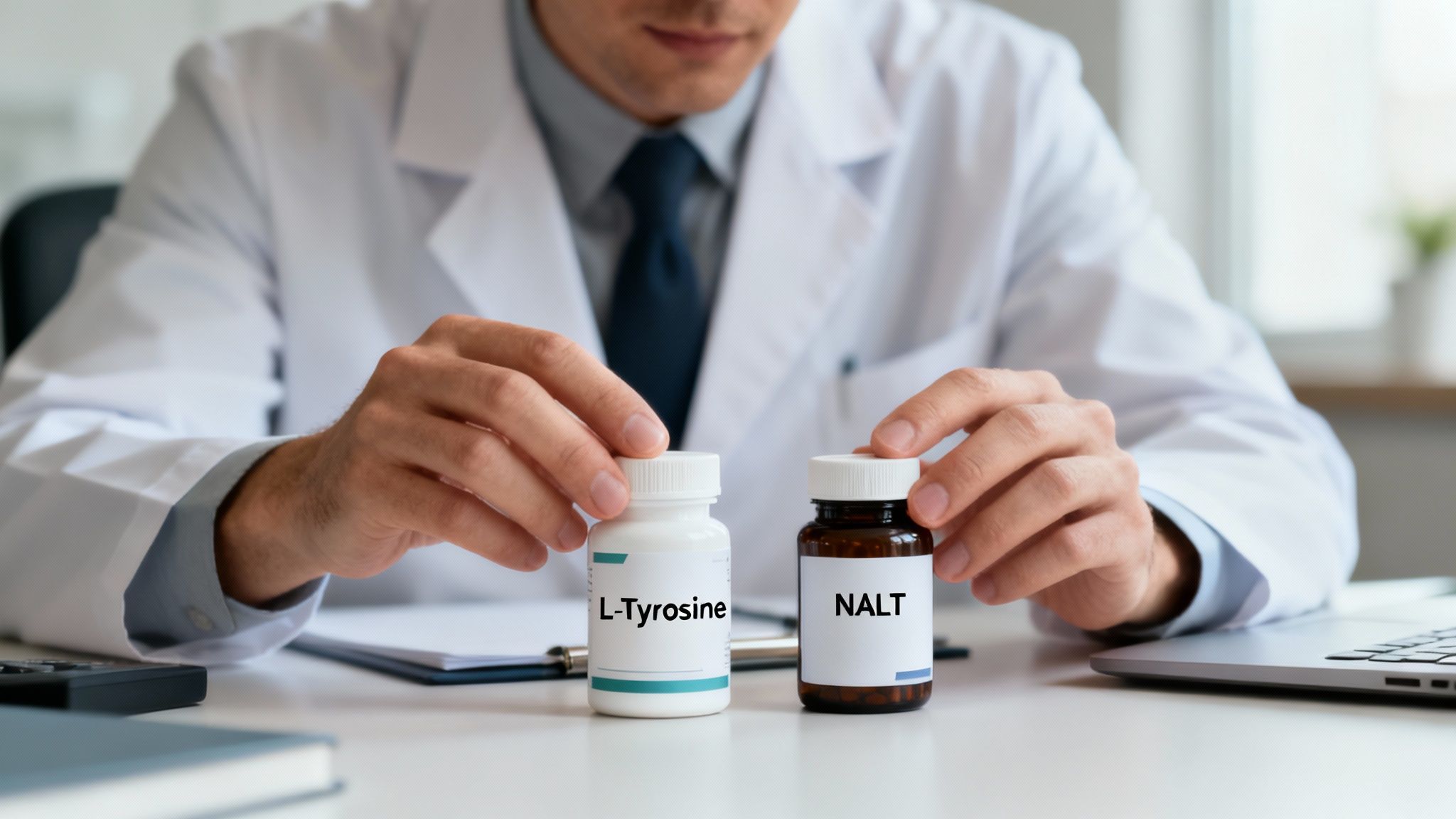
Whether you’re an athlete, entrepreneur, or student, you expect your supplements to work. The whole point of taking tyrosine is to fuel key neurotransmitters like dopamine and norepinephrine—the molecules that drive focus, motivation, and mental resilience under pressure. While both L-Tyrosine and NALT aim for this outcome, only one actually gets the job done when taken as a supplement.
The core difference is all about how your body processes each form. L-Tyrosine is the natural, free-form amino acid your body instantly recognizes and puts to work. NALT, on the other hand, is a modified version. Despite clever marketing about better solubility, the body struggles to convert it back into usable tyrosine.
You can get a deeper look at this modified form in our guide on what N-Acetyl L-Tyrosine is.
A Look at the Evidence
The scientific community has already settled this debate, and the data is pretty one-sided. Studies consistently show that taking L-Tyrosine orally can boost plasma tyrosine levels by a massive 130–276%.
So, what about NALT? It barely makes a dent, increasing levels by only 0–25%. One head-to-head study that tested four different tyrosine forms found NALT was the least effective of them all, making it a poor choice for delivering the mental clarity high-achievers need.
This is exactly why our Dialed In Nootropics Focus Pouches are formulated with L-Tyrosine. We build our products with ingredients backed by solid science to deliver real results. While our focus is cognitive performance, it’s always smart to understand the full performance landscape. For example, many athletes look into general nutrition supplements for runners to stack physical gains with mental ones.
Core Differences L-Tyrosine vs NALT at a Glance
For a quick breakdown, this table cuts straight to the chase, showing the key distinctions between these two popular nootropic ingredients.
| Key Factor | L-Tyrosine (Free Form) | N-Acetyl L-Tyrosine (NALT) |
|---|---|---|
| Oral Bioavailability | High; readily absorbed and used by the body. | Very Low; inefficiently converted to tyrosine. |
| Brain Impact | Effectively crosses the blood-brain barrier to boost neurotransmitters. | Struggles to cross the blood-brain barrier, resulting in minimal effect. |
| Proven Use Case | Backed by extensive research for enhancing cognitive function under stress. | Primarily useful for intravenous (IV) applications, not oral supplements. |
| Cost-Effectiveness | More economical and efficient, requiring lower doses for results. | More expensive and requires significantly higher doses for minimal effect. |
The takeaway is simple: If you're buying an oral supplement for focus and stress resilience, L-Tyrosine is the research-backed, effective choice.
The Chemistry: Why Form Matters
To really settle the N-Acetyl L-Tyrosine vs L-Tyrosine debate, we have to look at the chemistry. This isn’t just about what’s on the label; it’s about how these molecules actually behave inside your body to create a real effect. The tiny differences at a chemical level are what determine everything else, from absorption to brainpower.
L-Tyrosine is the natural, free-form amino acid your body is built to use. It’s found in protein-rich foods and is the direct building block for critical neurotransmitters. Think of it as a perfectly cut key, ready to fit the locks in your brain’s dopamine factory without any extra steps.
NALT, or N-Acetyl L-Tyrosine, is a modified version. It’s simply L-Tyrosine with an acetyl group tacked on. This chemical tweak was done for one reason: to make it dissolve better in water. And right there, a huge marketing myth was born.
The Solubility Myth: Why Dissolving Isn't Everything
On paper, NALT's superior water solubility seems like a clear win. The idea was that a compound that dissolves easily would absorb better from the gut into the bloodstream. This theory led a lot of supplement brands to jump on the NALT bandwagon, marketing it as a more advanced or “bioavailable” form of tyrosine.
But here’s the catch: bioavailability isn’t just about getting into the bloodstream. It’s about whether your body can use the molecule once it's there. That extra acetyl group, the very thing that helps NALT dissolve, becomes a major roadblock. For your body to access the tyrosine, it first has to snap off that acetyl group in a process called deacetylation.
It turns out our bodies, especially the kidneys and gut, are surprisingly bad at this specific task. A huge chunk of the NALT you swallow never gets converted into usable L-Tyrosine. Instead, it’s flagged as waste by your kidneys and flushed out before it ever gets a chance to cross the blood-brain barrier.
The real problem with NALT is its lousy conversion rate. The acetyl group that helps it dissolve also acts like a chemical shield, blocking your body from freeing the tyrosine molecule it actually needs for neurotransmitter production.
This metabolic bottleneck means that even if NALT makes it into your system, very little of it becomes the active L-Tyrosine your brain is craving. It’s like getting a key that’s been dipped in plastic—it might look shiny and new, but it’s useless until you painstakingly chip the coating off, probably breaking most of the key in the process.
The Lock and Key Analogy
Let’s make it simple. L-Tyrosine is the correct key, shaped perfectly to fit the enzymatic locks that turn it into L-DOPA and then into dopamine. It’s a direct, efficient process your body is already programmed to handle.
NALT, on the other hand, is a key that doesn't quite fit. Before it can even be put into the lock, your body has to perform a tricky modification—breaking off that acetyl group. This extra step is slow, inefficient, and for the most part, fails. The result? Most NALT molecules never even make it to the "lock."
This is a huge deal for anyone looking for a cognitive edge. The whole point of taking tyrosine is to give your brain more raw material to boost focus, drive, and mental resilience. Our guide on how to increase dopamine naturally dives deeper into why these foundational building blocks are so important. L-Tyrosine directly fuels this process, while NALT mostly gets lost in translation.
When you look at the science, the chemical structure of NALT makes it a functionally weaker choice for oral supplements, despite its solubility. The evidence is clear: studies show L-Tyrosine supplementation causes a significant, reliable spike in plasma tyrosine levels. NALT barely moves the needle. The chemistry doesn’t lie—for results you can count on, the natural form is the only way to go.
The Bioavailability Battle: Which Form Actually Enters the Brain?
When you’re comparing N-Acetyl L-Tyrosine vs. L-Tyrosine, the entire debate boils down to one crucial factor: bioavailability. It’s a simple concept—how much of a supplement your body can actually absorb, transport, and use to get a real effect. It doesn't matter how great an ingredient looks on paper if it can’t get where it needs to go.
For tyrosine, that destination is the brain. But getting there means crossing a highly selective security checkpoint called the blood-brain barrier (BBB). This barrier is designed to protect your central nervous system, only letting specific, recognized molecules pass through. And this is exactly where the battle between these two forms is won and lost.
L-Tyrosine, the natural free-form amino acid, is already on the VIP list. Your body’s transport systems recognize it, giving it an "all-access pass" to cross the BBB efficiently and become the raw material for neurotransmitters like dopamine. NALT, despite its impressive ability to dissolve in water, pretty much fails at this one critical step.
From Your Gut to Your Brain Cells
The journey of any nootropic is a race against time and your own metabolism. Once you take it, it has to survive your digestive system, get into the bloodstream, and finally make that all-important jump across the blood-brain barrier. When scientists tracked this journey for both L-Tyrosine and NALT, the results were incredibly one-sided.
Study after study shows that taking L-Tyrosine orally leads to a massive, reliable spike in plasma tyrosine levels. In stark contrast, studies on NALT show tiny—and sometimes nonexistent—changes in the bloodstream. That’s a huge red flag right there. If a compound can't even build up in your blood, it has zero chance of influencing your brain.
The problem is that the human body is just not very good at converting NALT back into usable L-Tyrosine. Most of the NALT you consume gets flagged as a foreign compound and is quickly flushed out by the kidneys, often before it even has a chance to be considered for brain uptake.
The core takeaway is this: solubility in a glass of water means nothing if your body can't metabolize the compound into a usable form. NALT's failure to convert into L-Tyrosine means most of it just becomes expensive waste.
Real-World Impact for High Performers
This isn’t just abstract science; it has direct consequences for the programmer who needs deep focus or the gamer needing split-second reflexes. When you take a nootropic, you’re looking for a reliable cognitive boost. All the evidence points to L-Tyrosine as the only form that consistently delivers.
This side-by-side comparison shows you exactly how your brain handles each form.
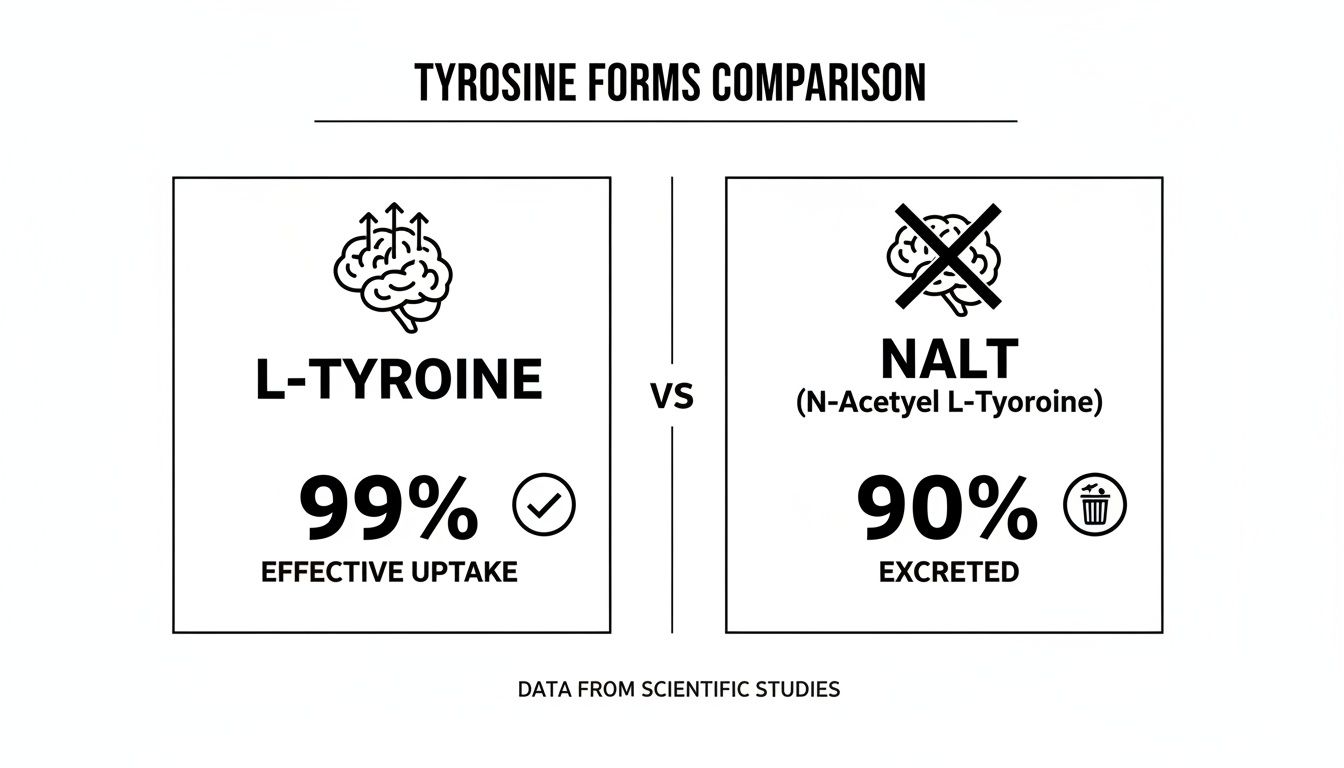
The visual makes it obvious: L-Tyrosine gets recognized and put to work, while NALT is largely blocked and thrown away.
For fitness buffs, police officers, and late-night designers, the real-world stats favor L-Tyrosine. Amid a 25% rise in nootropic use among 20- to 55-year-olds, L-Tyrosine has a proven track record of boosting cognitive control under stress. Meanwhile, NALT’s low conversion rate of under 60% means you’d have to take much larger doses for a minimal effect. Its famous intravenous solubility from the 1980s just doesn't carry over to oral use—brain uptake tests actually rank it among the worst of its kind. You can dig into the specifics in this comprehensive 2018 study.
Why the Right Choice Matters for Mental Clarity
At the end of the day, effective supplementation is all about getting the result you want. Whether you need to power through a complex coding problem, stay cool during a high-stakes meeting, or just remain sharp on a long drive, you need ingredients that actually work. The data is clear: L-Tyrosine effectively gives the brain the fuel it needs to perform under pressure.
Choosing the right form of tyrosine is fundamental to building a smart nootropic stack. This principle applies across the board—understanding how ingredients are absorbed is the key to achieving peak cognitive function. To learn more, check out our guide on the best supplements for mental clarity.
The science is definitive. For oral supplements aimed at enhancing your mind, L-Tyrosine is the clear winner in the bioavailability battle. It reliably gets into your bloodstream, crosses the blood-brain barrier, and supports the neurotransmitter production you need for focus, motivation, and mental resilience. NALT, despite the marketing hype, simply can't keep up.
When to Use L-Tyrosine: Real-World Scenarios
Knowing the science is one thing, but applying it is what gives high-performers an edge. The whole N Acetyl L Tyrosine vs L Tyrosine debate really comes down to this: when should you actually use it?
L-Tyrosine isn’t a passive, everyday supplement. It shines brightest during short bursts of intense stress—those moments when your brain is burning through its neurotransmitter fuel faster than it can be replaced.
Think of it this way: L-Tyrosine is a direct precursor to dopamine and norepinephrine, the brain chemicals that govern focus, motivation, and mental grit. Under normal circumstances, you have enough. But when you’re slammed with a high-pressure deadline or a grueling workout, your natural reserves can bottom out, leaving you with brain fog, fatigue, and a serious drop in performance.
Taking L-Tyrosine beforehand is like topping off your brain's fuel tank. It gives you the raw materials needed to stay sharp, driven, and resilient when it matters most.
The Student Facing Final Exams
Finals week is the classic burnout scenario. Long study sessions, sleep deprivation, and performance anxiety create a perfect storm for cognitive exhaustion. This is exactly where L-Tyrosine can be a game-changer.
- How It Helps: By feeding the dopamine system, L-Tyrosine helps shore up working memory, information processing, and the ability to switch between tasks—all critical for acing that exam.
- Recommended Use: Take 500mg–2,000mg about 30–60 minutes before a marathon study session or a big test to help fight off mental fatigue and maintain endurance.
The Tech Professional on a Deadline
Ever tried debugging complex code on three hours of sleep? Or managing a high-stakes product launch? The mental strain is immense. These jobs demand sustained concentration and the ability to solve problems on the fly without losing your cool.
L-Tyrosine is especially good for tasks requiring "cognitive flexibility"—the mental agility to pivot between different ideas or adapt to new information. It's invaluable when you're being pulled in a dozen directions at once.
For a professional staring down a tight deadline, L-Tyrosine can help maintain mental clarity and prevent the exhaustion that kills productivity. It supports the executive functions you need to stay organized and effective under pressure.
The Athlete Seeking a Competitive Edge
Physical stress is just as taxing on your brain as mental stress. An athlete heading into a competition needs more than just a warmed-up body; they need razor-sharp focus, quick decision-making, and pure motivation. L-Tyrosine helps connect physical readiness with mental performance.
Taking it before a big game or an intense training session can help sharpen reaction time and sustain cognitive function, even as your body starts to tire. In a competitive setting, that mental edge can be the difference between winning and losing. Of course, building the perfect stack is key, and a complete guide on finding the best nootropics for focus can offer a wider view.
Dialed In Nootropics: A Synergistic Approach
While L-Tyrosine is a powerhouse on its own, it works even better when combined with other smart ingredients. That’s the entire philosophy behind our Dialed In Nootropics Focus Pouches. We didn't just throw one ingredient in a pouch; we engineered a complete cognitive support system. You can purchase Dialed In Nootropics Focus Pouches here.
Our blend pairs L-Tyrosine with compounds like Citicoline for brain energy and L-Theanine for calm, focused alertness. This combination doesn't just provide the raw materials for neurotransmitter production—it supports overall brain health for alertness that is rapid, clean, and completely crash-free. It’s a smarter approach designed for peak mental performance.
Analyzing the True Cost and Value of Each Form
Beyond performance, a smart supplement strategy always comes down to cost-effectiveness. When you put N-Acetyl L-Tyrosine vs L-Tyrosine head-to-head on price, the argument is just as one-sided as the science. A quick glance at the shelf shows NALT is almost always more expensive, which makes sense given the extra chemical steps needed for acetylation.
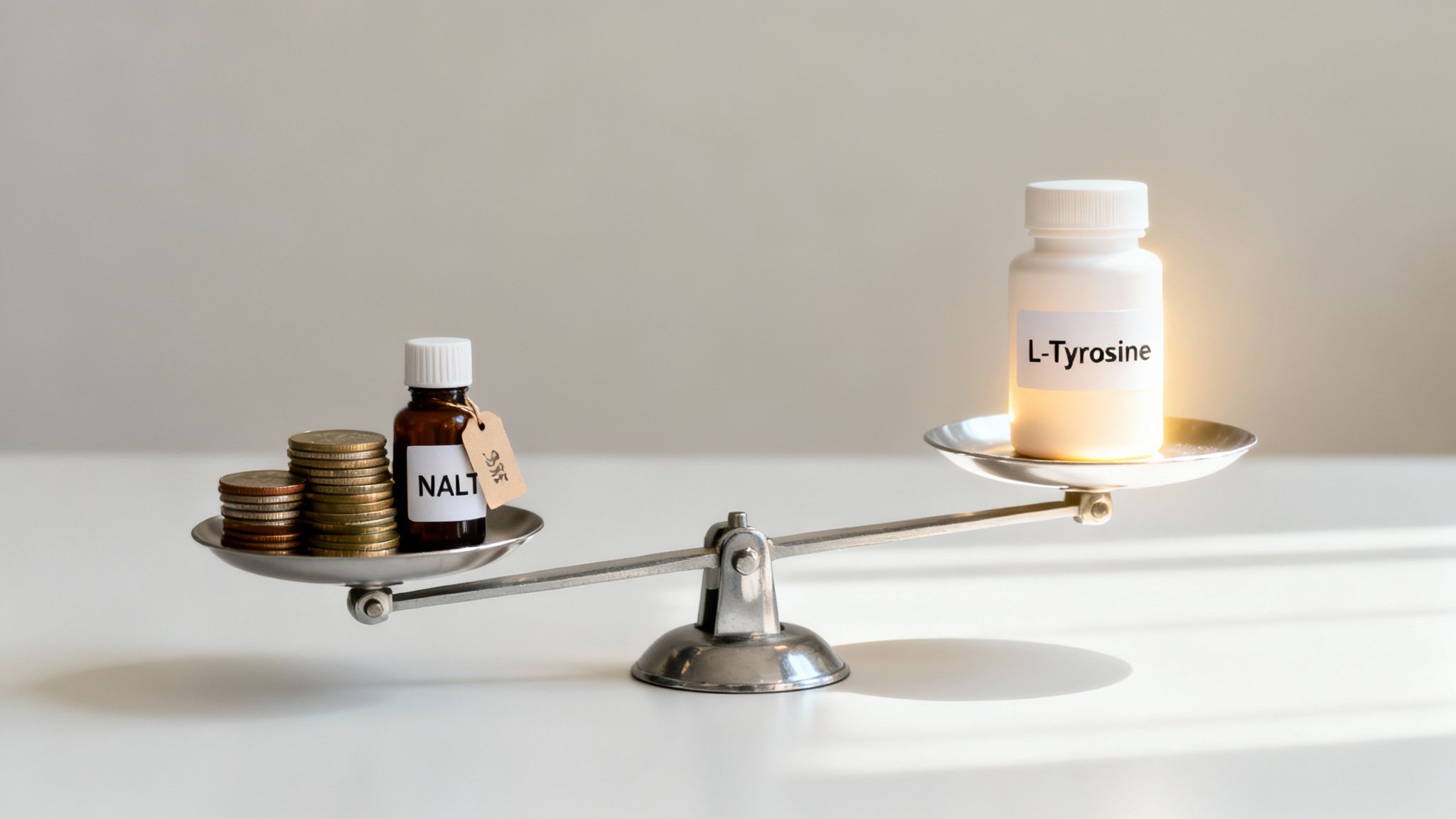
But here’s the problem: that higher price tag gives you zero corresponding benefit. In fact, NALT’s poor conversion and low bioavailability mean you’re paying a premium for an ingredient that delivers inferior results. It's a classic case of bad value.
The Real Cost of Inefficiency
The real kicker in this cost analysis is NALT’s awful conversion rate. So much of the NALT you take is simply excreted before your body can turn it into usable tyrosine. To even attempt to match the cognitive boost from L-Tyrosine, you’d need to take a much, much higher dose. This inefficiency dramatically inflates the true cost of using it.
Think of it like buying gasoline that’s 70% water—you’d have to buy three times as much just to get your car to run properly. That’s the financial reality of choosing NALT. You pay more for a product that forces you to use more to achieve less.
From a value perspective, NALT is a clear loser. The higher initial cost combined with the need for larger, less effective doses makes it an economically inefficient choice for anyone serious about results.
This reality shapes how supplements get made. L-Tyrosine stands out as the budget-friendly powerhouse, costing brands 30-50% less to produce than NALT. While those savings are often passed on, the bigger issue remains NALT’s inefficiency. Its low conversion rate means you need two to three times the dose for comparable effects, skyrocketing its true cost. The science is clear: you can pay less and get more with L-Tyrosine. Discover more insights about supplement formulation costs.
Our Commitment to No-Hype Formulations
At Dialed In Nootropics, our entire formulation philosophy is built on effectiveness and real-world value. We don’t chase marketing trends; we choose ingredients backed by solid scientific evidence. Selecting L-Tyrosine for our Focus Pouches was a deliberate decision based on its proven bioavailability and superior ability to fuel cognitive function.
This commitment ensures our customers aren't paying extra for hyped-up, ineffective ingredients. Instead, you get a precisely engineered product that delivers tangible results without wasting your money. You can buy our Focus Pouches directly from our website. L-Tyrosine provides the proven cognitive benefits you’re looking for, making it the clear winner in both performance and value.
So, Which One Should You Actually Use?
When you cut through the noise in the N Acetyl L Tyrosine vs L Tyrosine debate, there’s a clear winner for anyone taking an oral supplement to get a real cognitive edge. After looking at the chemistry, how the body absorbs it, and what the evidence shows, the answer is pretty straightforward.
For sharpening your focus under pressure, boosting motivation, and getting the most value for your money, L-Tyrosine is the only scientifically validated choice.
It all boils down to one simple fact: your body knows what to do with it. L-Tyrosine’s natural form is easily absorbed and crosses the blood-brain barrier efficiently. NALT, on the other hand, gets flushed out by your body before it can do much good, making it a poor choice for actually boosting those key neurotransmitters.
Matching Your Supplement to Your Goal
Your specific goals should always drive your supplement strategy. If you're an athlete who needs a mental advantage before a big game, a student cramming for exams, or a professional fighting off burnout, L-Tyrosine gives your brain the direct fuel it needs to perform. This isn't about theory; it's about results you can feel.
For just about any goal you'd have for oral supplementation, the evidence stacks up in favor of L-Tyrosine. Its proven ability to raise brain tyrosine levels translates directly into better cognitive function when it matters most.
This science-first philosophy is exactly why we created Dialed In Nootropics. We formulated our Focus Pouches with effective, research-backed ingredients like L-Tyrosine to deliver clean, fast, and sustained cognitive enhancement. We skip the marketing hype and stick with ingredients that actually work.
Experience the Difference That Science Makes
We invite you to feel that difference for yourself. Our Focus Pouches are engineered with a synergistic blend of nootropics that support focus, clarity, and mental endurance without the crash. By choosing the right ingredients from the start, we help you unlock your peak performance.
To get a wider view of cognitive health, you can check out our detailed guide on the best supplements for concentration.
And for those curious about other avenues for health and performance, there's a wide range of nutritional supplements available from trusted sources to explore.
Ultimately, picking the right supplement is an investment in your performance. Don't waste your time or money on ingredients that don't deliver. Elevate your cognitive game with a formula built on proven science and tangible results. Buy Dialed In Nootropics Focus Pouches today.
Common Questions About L-Tyrosine
When you're dialing in your supplement routine, a few key questions always pop up. Here are straight-up answers to the most common queries about L-Tyrosine vs. N-Acetyl L-Tyrosine.
Can I Take L-Tyrosine Every Day?
You can, but you probably shouldn’t. L-Tyrosine shines brightest when used tactically to combat acute stress or right before a heavy cognitive lift, like a major exam or a competitive gaming session.
Think of it as a tool you pull out when you need it most. Cycling its use—saving it for high-demand situations—helps maintain its powerful effects long-term. And as always, run any new supplement by your healthcare professional to make sure it’s a good fit for you.
What's the Best Time to Take L-Tyrosine for Focus?
Timing is everything. For the sharpest mental edge, take your dose on an empty stomach about 30-60 minutes before you need to perform.
This gives your body just enough time to absorb the amino acid and get it to your brain, right when the pressure is on. Taking it before a tough workout, a high-stakes presentation, or a long study session ensures your neurotransmitter reserves are full for peak performance.
Does L-Tyrosine Have Any Side Effects?
Most people handle L-Tyrosine just fine, especially at recommended doses. On occasion, some might experience mild side effects like a headache or an upset stomach.
This usually only happens with higher doses. The smart move is to start with a lower dose to see how your body responds and only increase it if you need to.
So why do some brands still use NALT? It often comes down to outdated information or marketing fluff about its water solubility. At Dialed In, we build our formulas on the latest science, which points overwhelmingly to L-Tyrosine's superior bioavailability and real-world effectiveness for cognitive enhancement.
This evidence-first approach means you get a product that delivers measurable results without the hype.
At Dialed In Nootropics, we use scientifically validated ingredients like L-Tyrosine to give you clean energy and sharp focus exactly when you need it. See what a science-backed formula can do for you and explore our Focus Pouches.