

Best Ways to Improve Cognitive Function: best ways to improve cognitive function
If you’re hunting for the best ways to improve cognitive function, you'll find the answer isn’t a single hack. It's about building a sustainable ecosystem where your brain can thrive. Think of it as cultivating a garden—it requires consistent care across a few key areas. The core pillars are structured lifestyle habits, continuous mental stimulation, and targeted nutrition.
Your Guide to Lasting Cognitive Enhancement
Improving cognitive function isn't about finding one magic bullet. It’s about creating a powerful synergy between how you live, what you learn, and how you fuel your brain. Forget generic advice. This is your practical blueprint for building mental resilience, sharpening your focus, and protecting your brain for the long haul.
We'll break down how these different elements feed into each other, creating an upward spiral. When your physical health improves, your thinking gets sharper. And when your mind is stimulated, sticking with those healthy habits becomes a whole lot easier.
The infographic below shows exactly how lifestyle, mental stimulation, and nutrition form the bedrock of cognitive enhancement.
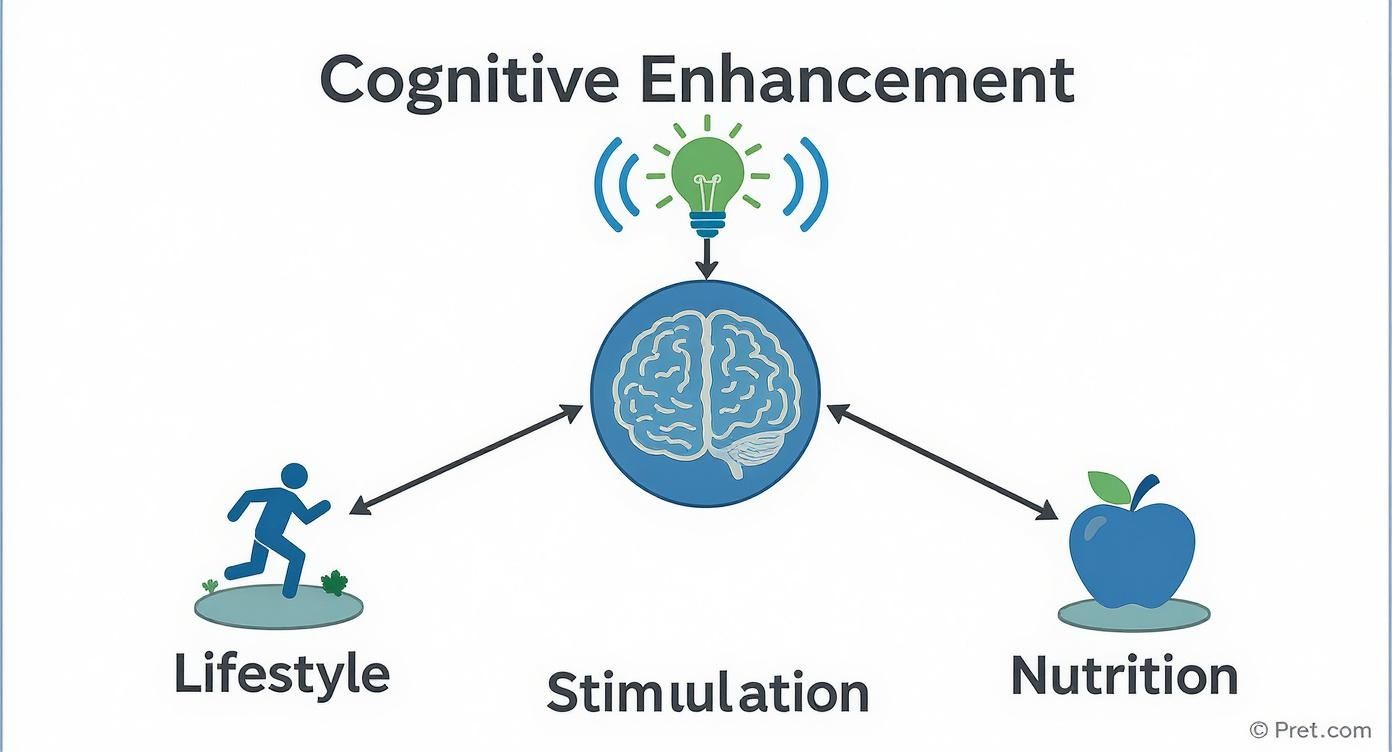
This illustrates a simple but powerful truth: a truly effective strategy addresses your brain’s health from every angle, not just one.
The Foundation of Brain Health
Imagine your brain is a high-performance engine. To keep it running at its peak, it needs three critical inputs:
- Quality Fuel: This comes from a diet packed with brain-boosting nutrients like Omega-3s, antioxidants, and vitamins. They protect brain cells and keep the communication lines between neurons firing smoothly.
- Regular Maintenance: Think of consistent exercise and quality sleep as your daily tune-up. This clears out metabolic waste and strengthens the neural pathways you build every day.
- Active Use: Continuously challenging your mind with new skills and complex problems is like taking that engine for a spin. It keeps it powerful, responsive, and ready for anything.
Nailing these core areas creates the ideal conditions for your brain to operate at its absolute best. It’s the essential groundwork for achieving the kind of sustained focus needed for deep work and peak productivity. For anyone looking to take their concentration to the next level, our guide on how to achieve flow is the perfect next step. This foundational approach sets the stage long before you ever need to consider supplemental support.
Core Pillars of Cognitive Enhancement at a Glance
To make this simple, we've broken down these foundational concepts into a quick-reference table. This gives you a clear snapshot of the key actions and their direct benefits for your brain.
| Strategy Area | Key Action | Primary Benefit |
|---|---|---|
| Lifestyle Habits | Prioritize 7-9 hours of quality sleep and engage in regular physical activity. | Improves memory consolidation, clears brain fog, and enhances neuroplasticity. |
| Mental Stimulation | Learn a new skill, read challenging books, or solve complex problems. | Builds cognitive reserve, strengthens neural networks, and delays cognitive decline. |
| Targeted Nutrition | Consume a diet rich in Omega-3s, antioxidants, and B vitamins. | Protects brain cells from damage, supports neurotransmitter function, and reduces inflammation. |
This table highlights that consistent, small efforts across these three domains compound over time, leading to significant and lasting improvements in your mental performance.
Building Your Brain-Healthy Lifestyle
The first step to sharpening your mind isn't a complex biohack—it’s built on the small, consistent choices you make every single day. Forget seeing lifestyle changes as a chore. Think of it as training for a mental marathon.
When you get your physical health in order, it creates this incredible upward spiral that sharpens processing speed, boosts executive function, and builds a solid defense against cognitive decline.
This isn't just a hunch; it's backed by serious science. A major two-year U.S. clinical trial showed that structured lifestyle changes delivered massive cognitive improvements for older adults at risk of decline. The group following a deliberate plan saw a statistically significant jump in their cognitive scores compared to a group just given general advice. That proves a focused approach really works. You can read more about the study’s powerful findings on Alz.org.
The takeaway is simple: your brain's performance is directly tied to your body's health.
The Power of Physical Activity
Think of a good workout as fertilizer for your brain cells. When you get your heart rate up, your body releases a protein called brain-derived neurotrophic factor (BDNF). It’s absolutely critical for the growth, survival, and maintenance of your neurons—basically, it helps build and repair your brain's wiring.
Regular exercise, especially aerobic stuff like running or cycling, floods your brain with oxygen and nutrients while clearing out junk. This whole process fires up neuroplasticity—your brain’s ability to form new connections—which is proven to improve memory, focus, and thinking speed. A great target to aim for is at least 150 minutes of moderate aerobic exercise a week.
Physical activity is one of the most effective tools we have for keeping our brains fit. It unleashes growth factors that help your mind adapt, learn, and stay resilient.
Remember, consistency beats intensity. Even a brisk daily walk adds up to a huge impact over time.
Strategic Nutrition with the MIND Diet
Just like a high-performance car needs the right fuel, your brain demands high-quality nutrition to run at peak capacity. One of the most effective, research-backed approaches is the MIND diet, a smart blend of the Mediterranean and DASH diets designed specifically for brain health.
The MIND diet isn’t about cutting everything out; it’s about loading up on the right stuff. The goal is to eat more foods known to protect the brain and limit the ones that cause inflammation and stress.
Here’s what that looks like in your shopping cart:
-
Brain-Protective Foods to Load Up On:
- Green Leafy Vegetables: Packed with nutrients like folate and vitamin K.
- Berries: Loaded with flavonoids that act as powerful antioxidants.
- Nuts and Seeds: Great sources of vitamin E and healthy fats.
- Olive Oil: Your go-to for healthy monounsaturated fats.
- Fish: Full of omega-3s, the actual building blocks for your brain cells.
-
Foods to Keep to a Minimum:
- Red meats and processed junk.
- Fried foods and fast food.
- Sweets, pastries, and refined sugar.
- Butter, margarine, and full-fat cheese.
When you nail these daily habits, you're giving your brain the raw materials it needs to fire on all cylinders. That’s when a powerful nootropic like Dialed In can really shine, acting as a performance amplifier on top of the strong foundation you’ve already built. Check out our science-backed nootropic gum and pouches to see how they can support your brain-healthy lifestyle.
Fueling Your Brain with Lifelong Learning

The old saying "use it or lose it" is more than just a cliché—it's the bedrock of long-term brain health. To keep your mind sharp, you have to keep it moving. This isn't about doing the same simple crossword puzzle every morning; it's about actively seeking out novelty and complexity.
Think of your brain's neural pathways as trails winding through a dense forest. The more you walk a specific trail, the wider and clearer it gets. Learning something new is like forging a completely new path, making your entire neural network stronger and more connected.
Building Your Cognitive Reserve
This process of forging new connections builds what scientists call cognitive reserve. You can think of it like a mental savings account. Every time you challenge your brain by learning a new skill or grappling with a tough concept, you’re making a deposit.
A solid education is one of the biggest initial investments you can make in this reserve. In fact, large-scale international studies have found a powerful link between education levels and cognitive function in older adults. Seniors in countries with higher educational attainment consistently show better cognitive performance, proving just how crucial early learning is for building mental resilience.
But this reserve isn't just about being "smarter" today. It acts as a buffer, helping your brain withstand the natural challenges of aging. It's the backup generator that keeps the lights on, even when some of the main circuits start to wear down.
Lifelong learning isn’t just about memorizing facts. It's about actively rewiring your brain to be more flexible, efficient, and resilient against future decline.
Practical Ways to Challenge Your Brain
Building this reserve should be an ongoing project—one that’s genuinely exciting. The trick is to pick activities that are both complex and new to you.
Here are a few powerful ways to get started:
- Learn a New Language: This is a full-brain workout, hitting memory, logic, and auditory processing all at once. It forces your brain to operate within entirely new structures.
- Pick Up a Musical Instrument: Learning music involves coordinating multiple senses with fine motor skills, which dramatically strengthens connections between different brain regions.
- Engage in Strategic Games: Chess, Go, or even complex board games demand critical thinking, planning, and adaptation, giving your executive functions a serious workout.
These kinds of activities are fantastic for building mental adaptability. If you want to dive deeper into this crucial skill, check out our guide on how to improve cognitive flexibility.
To really level up your learning, explore advanced memory retention techniques. The more you vary your mental workouts, the stronger your brain’s foundation becomes.
And for an extra edge, Dialed In Nootropics deliver the clean energy and focus needed to tackle these new challenges head-on.
Challenging Your Brain with Daily Exercises
Alright, let's move from theory to action. It’s time to build your toolkit of practical cognitive exercises that actually get results. The real secret to mental growth is pushing yourself just past your comfort zone—not miles past it, but just enough to feel the stretch.
Think of it like lifting weights at the gym. You don't build muscle by picking up the same five-pound dumbbell every single day. To forge new neural pathways, you have to introduce novelty and just the right amount of complexity.
These "brain workouts" are most powerful when you pair them with the smart lifestyle and nutrition habits we’ve already covered. This creates a complete system for boosting your cognitive performance. A consistent routine isn't just a nice idea; it's one of the best ways to sharpen your mind for the long haul.
And the science backs this up. Regularly engaging in cognitively demanding activities is strongly linked to preserving brain function as we age. One major study followed 1,168 older adults and found that those who frequently read or played games had significantly better cognitive scores over time. You can read the full research about these cognitive findings on PMC.
Designing Your Mental Workout Routine
The goal here is to build a personal routine that’s both effective and genuinely fun. Let’s be honest—if you don't enjoy it, you won't stick with it. The trick is to mix things up to target different parts of your brain.
Just like a good gym routine hits your legs, back, and shoulders, a solid mental workout should challenge different brain functions. This ensures you’re building well-rounded cognitive fitness, not just getting really good at one thing.
Here’s how different activities train specific mental "muscles":
- Strategic Games (Chess, Go): These are fantastic for your executive functions. They force you to plan ahead, adapt to your opponent's moves, and think several steps into the future—a direct workout for your prefrontal cortex.
- Creative Hobbies (Painting, Music): Learning an instrument or picking up a paintbrush builds powerful new connections across different brain regions. You're integrating what you see and hear with fine motor control, which fuels both creativity and problem-solving.
- Complex Reading (Non-Fiction, Science): When you tackle a dense book on a subject you know little about, you force your brain to build new mental models from scratch. It’s a direct workout for your analytical reasoning and comprehension skills.
Actionable Exercises to Start Today
Ready to get started? The best brain exercises feel more like a passion project than a chore. The key is finding something that grabs your attention and always offers a new level of difficulty to conquer.
Try adding just one or two of these to your weekly schedule:
- Master a New Skill: Sign up for an online course in a totally new field. It could be coding, astronomy, a new language, or philosophy. The process of learning from square one is a massive trigger for neuroplasticity.
- Work on Puzzles: Go beyond the daily crossword. Try Sudoku, complex logic puzzles, or even building an intricate model. These activities are phenomenal for training your working memory.
- Practice Mindfulness Meditation: It might look passive, but meditation is an intense exercise in attention control. You're actively training your brain to focus, ignore distractions, and manage your thoughts—all essential cognitive skills.
These exercises are designed to be challenging but totally achievable. If you want to dive deeper, our guide on specific ways to improve working memory is a great next step.
And for those days when you need an extra gear of mental energy to tackle that new challenge, Dialed In Nootropics can deliver the clean focus you need to stay sharp and on point.
Using Nutrition and Nootropics for Peak Performance

Your brain is an incredibly high-performance machine. It’s also a hungry one, consuming a massive 20% of your body's total calories just to run the show—from deep thinking to keeping the lights on.
This means what you eat isn't just fuel for your body; it's the raw material for your thoughts, focus, and clarity. Think of nutrition as the non-negotiable foundation you build everything else on top of. Once that base is solid, you can start adding targeted tools to truly optimize your mental game.
The Essential Brain-Fueling Nutrients
To perform at its best, your brain needs a steady supply of specific, high-quality nutrients. These compounds are the building blocks that protect brain cells, support lightning-fast communication between neurons, and fight off the oxidative stress that makes you feel foggy and slow.
Without them, even the best sleep and exercise habits won't get you to 100%. Here are the nutrients you absolutely need:
- Omega-3 Fatty Acids: Found in fatty fish like salmon, these are literally what your brain cell membranes are made of. They’re critical for smooth communication between neurons and are heavily linked to better memory and learning.
- Flavonoids: These are powerful antioxidants found in foods like berries and dark chocolate. They act like a security detail for your brain, protecting it from inflammation and cell damage to help maintain long-term cognitive vitality.
- Antioxidants and Vitamins: Foods like citrus fruits, leafy greens, and nuts are loaded with vitamins C and E. They defend your brain cells against the constant assault of free radicals, keeping your internal hardware running clean.
For a simple but effective boost, check out the Sencha green tea benefits for focus and vitality—it’s a great addition to any nutritional toolkit.
Amplifying Your Efforts with Targeted Nootropics
Once you’ve got your nutritional foundation dialed in, high-quality nootropics can step in to provide targeted support, taking your performance from good to great. They aren't a replacement for healthy habits, but a powerful amplifier for the hard work you're already putting in.
A well-formulated nootropic isn't a magic pill. It's a strategic tool designed to sharpen specific cognitive functions, working with your brain's natural chemistry to help you achieve greater clarity and efficiency when it matters most.
Nootropics are designed to complement a healthy lifestyle, providing the final edge needed to sharpen focus, support memory recall, and enhance mental clarity when you need it most.
Our formulas at Dialed In are built to do exactly that, offering a clean, crash-free way to support your mental output. You can go deeper on this topic by reading our guide on the best supplements for mental clarity.
Ready to give your brain the targeted support it deserves? You can explore our science-backed formulas and purchase Dialed In Nootropics directly from our website to experience the difference for yourself.
Making These Strategies Part of Your Daily Life

Real cognitive improvement isn't about some drastic, week-long overhaul. It's built on small, consistent actions that eventually become second nature. The truth is, the best ways to improve cognitive function are the ones you actually stick with.
This is your game plan for turning these science-backed ideas into real, lasting habits. It boils down to a simple formula: a healthy lifestyle, an engaged mind, and smart nutrition. The key is to start small so you can build momentum without burning out.
Your Action Plan for Integration
Forget trying to change everything overnight. That’s a recipe for failure. Instead, focus on weaving one or two new habits into your life at a time. This makes consistency feel almost effortless.
- Start Small: Pick one thing. A 20-minute walk after dinner. Reading a single chapter of a tough book before bed. That's it.
- Stack Habits: Link your new brain-boosting activity to something you already do. Practicing a new language on an app while your morning coffee brews is a classic example.
- Track Progress: After a week, just take a moment to notice how you feel. Are you a little sharper? More energized? Recognizing those small wins is what keeps you going.
The goal isn’t perfection. It's persistence. Think of every healthy meal, every challenging puzzle, and every good night of sleep as a deposit into your cognitive bank account. It all compounds over time.
To really sharpen your thinking and complement these efforts, check out our guide on how to improve mental clarity.
Ready to give your new routine a running start? Purchase Dialed In Nootropics from our website and see how our formulas can support you on your journey.
Your Questions Answered
When you start digging into brain health, questions are bound to pop up. Let's tackle some of the most common ones so you can feel confident putting these strategies to work.
How Long Until I Actually Feel a Difference?
Think of it less like a switch and more like getting in shape. You might feel a noticeable bump in focus or mental clarity within a few days of cleaning up your sleep or nutrition, but the real, lasting gains in memory and processing speed take time. We’re talking weeks or even months of sticking with it.
The secret is consistency. Small, daily deposits—a brisk walk, a tough puzzle, a brain-friendly meal—compound over time. You're not just having a good day; you're building a more resilient, high-performance brain.
Is It Possible to Reverse Cognitive Decline?
While some cognitive changes with age are normal, the research is overwhelmingly clear: your lifestyle choices can dramatically slow down the process and, in some cases, even improve your cognitive scores. Things like regular exercise, a brain-protective diet (like the MIND diet), and always learning new skills are your best defense.
These activities fire up neuroplasticity—your brain's incredible ability to rewire itself and form new connections. This builds up your "cognitive reserve," giving you the mental firepower to stay sharp for the long haul.
You can't turn back the clock, but you can absolutely keep the engine running smoothly. Think of these daily habits as the ultimate tune-up for your brain.
Can I Just Use Nootropics Instead of Eating Healthy and Exercising?
Absolutely not. Nootropics are best seen as performance amplifiers, not replacements for the fundamentals. A healthy lifestyle—good sleep, regular movement, and a nutrient-rich diet—is the non-negotiable foundation for your brain to function at its best.
Once that foundation is rock-solid, a well-formulated nootropic can give you a targeted edge. It can help sharpen your focus for a big project, enhance mental clarity during a complex task, or support memory when you really need it. They work with the good habits you've already built, not in place of them.
Ready to amplify the hard work you're already doing? Dialed In Nootropics deliver the clean, targeted support to complement your healthy lifestyle and keep you at the top of your game. Check out our science-backed formulas and purchase your Dialed In Focus Gum and Nootropic Pouches today.