

How to Improve Decision Making Skills for Peak Performance
Being good at making decisions isn't a gift—it's a skill. And like any other skill, you can train it. It comes down to mastering a few key areas: using mental frameworks, fighting back against your own biases, and getting your biology to work for you, not against you.
This approach is what separates amateurs from pros in any high-stakes field. It turns decision-making from a guessing game into a reliable, deliberate process.
Why Your Decision Making Skills Define Your Success
In a world drowning in data, the ability to make a sharp, effective call is everything. It’s no longer a "soft skill"—it’s the engine that drives your career, your finances, and your personal growth. The modern economy doesn't reward hesitation; it rewards those who can cut through the noise with clarity and conviction.
This isn't just a feeling; the numbers back it up. Back in 1960, only 6% of jobs were considered decision-heavy. By 2018, that number exploded to 34%. Research also shows that people with better economic decision-making skills earn 10% more in management and other demanding roles. That advantage adds up big time over a career.
The New Currency of Performance
Today's top performers—whether they're tech professionals, athletes, or first responders—are defined by the quality of their choices under pressure. Think about it. A developer picking the right software architecture, a quarterback reading the defense in a split second, or a paramedic making a life-or-death call all rely on the exact same core ability: process information fast and act decisively.
This guide is built on three pillars to help you forge this critical skill.
The Three Pillars of Elite Decision Making
To get you started, here's a quick look at the core strategies we'll be breaking down. These aren't abstract theories; they're the foundational blocks for building a reliable system for making better choices, every single time.
| Pillar | What It Is | Why It Matters for You |
|---|---|---|
| Mastering Mental Frameworks | Structured models (like OODA loops or decision trees) that bring logic to complex problems. | They get you out of your own head and provide a clear path forward, moving you beyond just "gut feelings." |
| Countering Cognitive Biases | Identifying and neutralizing the hidden mental shortcuts that trip up even the smartest people. | Your brain is wired to take shortcuts. Recognizing them stops you from making predictable, unforced errors. |
| Optimizing Your Biology | Understanding how sleep, nutrition, and stress directly impact your brain's performance. | You can't make sharp decisions if your brain is running on fumes. This is about building the physical foundation for mental clarity. |
Each pillar supports the others, creating a powerful system for consistent, high-quality output.
"The quality of your life is a direct reflection of the quality of the decisions you make."
This isn't just about making one or two "good" choices. It’s about building a reliable system that works consistently.
The mental clarity and strategic thinking required are deeply tied to your executive functions—the cognitive skills that manage your attention, planning, and self-control. To build this foundation, knowing how to start improving executive function in adults is a crucial first step.
By treating decision-making as a discipline you can train, you’re making one of the highest-return investments in yourself possible. The strategies we're about to cover are practical and ready to use, whether you're leading a team or just trying to get more done.
For a deeper dive into more foundational techniques, this comprehensive guide on improving decision-making skills is another excellent resource.
Let’s get started building your toolkit.
Adopt Proven Frameworks for Clearer Choices
Relying on your gut is a gamble, especially when precision and clarity are what get you ahead. If you’re serious about improving your decision-making, it’s time to move beyond pure instinct and start using structured mental models. A great starting point is to adopt proven decision-making frameworks that give you a reliable roadmap for navigating complex choices.
These aren't just abstract theories you'd find in a textbook. They are battle-tested tools used daily by military strategists, top executives, and elite athletes to slice through uncertainty and act with conviction. Frameworks essentially force you to map out your thought process, making it much easier to spot holes in your logic and weigh your options without bias.
This graphic gives you a high-level look at the entire process.
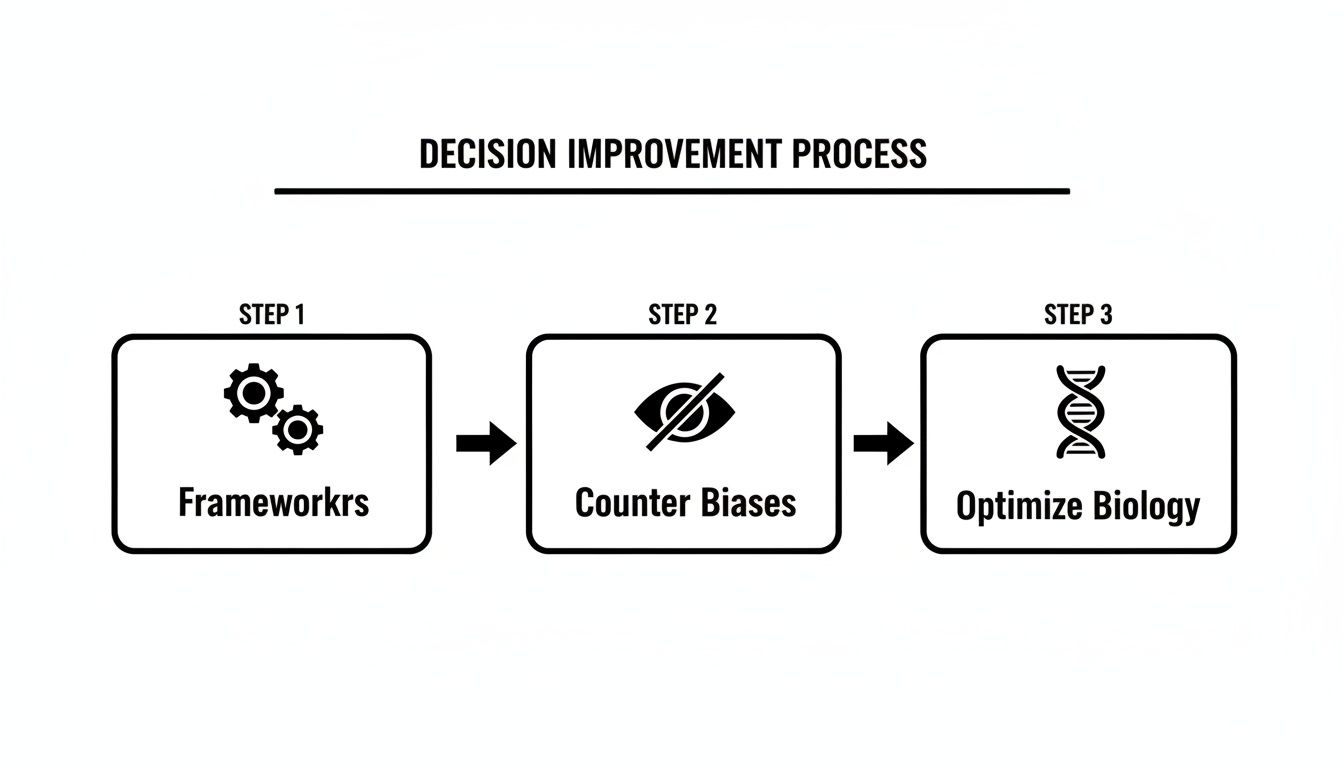
It’s a three-part journey: start with solid frameworks, learn to spot and counter your own cognitive biases, and finally, get your biology working for you, not against you.
The OODA Loop for Competitive Agility
Developed by legendary military strategist John Boyd, the OODA Loop is a simple but brutally effective cycle for out-thinking an opponent. It’s all about speed and accuracy. It breaks down into four stages: Observe, Orient, Decide, and Act.
Let's say you're an entrepreneur who just saw a competitor slash their prices. Here's OODA in action:
- Observe: You immediately start gathering intel. What are their new prices? How are customers reacting on social media? What’s happening to your own download numbers?
- Orient: Now, you process that information. This is the key step. You put the data into the context of your own strategy, your cash flow, and your market position. You’re not just reacting; you’re making sense of the new landscape.
- Decide: Based on your orientation, you commit to a plan. A price war might be a losing game, so you decide to double down on a unique feature that your competitor can't match.
- Act: You execute. A targeted marketing campaign goes live, hammering home your app's superior value proposition.
By running through this loop faster and better than your competition, you seize the initiative and dictate the terms of the game.
The Decision Matrix for Objective Comparisons
Ever find yourself stuck between several really good options? A Decision Matrix is the perfect tool to untangle the knot and make a choice based on logic, not emotion. It’s a favorite among project managers who need to back their decisions with hard data.
Imagine you're picking new software for your team. You’d start by listing the options in rows and your non-negotiable criteria in columns—things like cost, ease of use, integration capability, and customer support.
Next, you score each option against every criterion (say, on a 1-5 scale) and assign a weight to each criterion based on its importance. The software with the highest final score is your logical winner. This simple grid removes personal bias from the equation and gives you a clear, defensible reason for your choice. This kind of systematic thinking is crucial when you need to get into deep focus, or a "flow state." In fact, learning how to achieve flow can make applying these analytical frameworks even more effective.
The Premortem Technique to Mitigate Risk
Most teams run a "postmortem" to figure out what went wrong after a project has already failed. The Premortem technique is a genius flip of that script—it’s about preventing the failure before it even has a chance to happen. Think of it as weaponized pessimism.
Before a big project launch, get your team in a room. Ask them to imagine it’s six months from now, and the project has been a complete, catastrophic failure. Then, have everyone silently write down every reason they can think of for why it failed.
This simple exercise is incredibly powerful. It surfaces all the hidden risks and unspoken fears that people were too hesitant to bring up before. You might uncover a critical dependency you overlooked, a flawed assumption in your initial plan, or a market shift you hadn't considered. By getting these threats out in the open from day one, you can build a far more resilient strategy.
Recognize and Outsmart Your Cognitive Biases
Even the sharpest decision-making frameworks can fall flat if your thinking is skewed. Your brain is wired with mental shortcuts, known as cognitive biases, that quietly sabotage your choices without you even realizing it. Spotting these hidden traps is a huge part of getting better at making decisions.
Ever seen a founder pour more cash into a failing project just because they've already invested so much time and money? That’s the classic Sunk Cost Fallacy in action, where past investments wrongly justify future ones.
Or what about a manager who hires someone because they remind them of a younger version of themselves, passing over a more qualified applicant? That's Confirmation Bias—our tendency to favor information that confirms what we already believe.
These biases aren't a personal failing; they're just part of how our brains work. The goal isn't to magically erase them (which is pretty much impossible), but to build systems that act as guardrails against them.

Appoint a Devil's Advocate
One of the best ways to battle bias is to intentionally introduce some healthy conflict. Before you lock in a big decision, assign someone on your team the role of "devil's advocate." Their only job is to argue against the popular opinion and poke holes in the plan.
This gives people a license to challenge the status quo without being seen as negative or difficult. It stress-tests your assumptions and almost always uncovers blind spots you would have missed. This mental sparring forces a much deeper look at the problem and leads to a stronger outcome. Building this kind of mental agility is key, and learning how to improve cognitive flexibility makes this entire process even more effective.
Actively Seek Disconfirming Evidence
By default, your brain hunts for information that proves you right. To fight this, you need to make a conscious effort to find evidence that proves you wrong.
- For a business decision: Instead of just reading case studies about companies that succeeded with a strategy you like, actively search for the ones who tried it and failed spectacularly.
- For a personal choice: If you're totally sold on making a specific investment, spend a solid hour reading the most convincing arguments against putting your money there.
This feels completely backward at first, but it's crucial for getting a balanced view. It pulls you out of your own echo chamber and makes sure your final call is based on reality, not just wishful thinking.
The modern world is making this harder than ever. A recent global study found that 74% of people feel their daily decisions have multiplied tenfold in just three years. This has led to what 85% are calling 'decision distress'. It's so bad that 70% of business leaders admit they'd rather just let a robot decide for them. You can read the full research on decision overload here.
Use a Clean Slate Approach
When you're looking at an ongoing commitment—a project, a job, an investment—it’s so easy to be influenced by the time and energy you’ve already poured in. The "clean slate" approach helps you snap out of that trap.
Just ask yourself one simple question: "Knowing what I know now, if I weren't already committed to this, would I start it today?"
If the answer is a clear "no," that’s a massive red flag that you're caught in the Sunk Cost Fallacy. This mental reset forces you to look at the situation based on its current value and future potential, not its past.
Optimize Your Biology for Peak Cognitive Performance
Mental frameworks and bias awareness are powerful, but they’re only half the battle. High-quality decision-making is a biological process as much as a mental one. You can't run sophisticated cognitive software on outdated hardware—and your brain and body are that hardware.

This means your cognitive output is directly tied to fundamentals like sleep, nutrition, and stress management. Neglecting these is like trying to win a race with a flat tire. No amount of skill can overcome a system failure.
Fuel Your Brain for Clarity
Your brain is incredibly energy-intensive, consuming about 20% of your body's total calories despite making up just 2% of your weight. What you eat directly fuels its ability to process information and make sharp judgments.
Think of it this way: certain foods are targeted support for key neurotransmitters.
- Complex Carbohydrates: Oats and sweet potatoes provide a slow, steady release of glucose. This prevents the mental fog that comes from the blood sugar rollercoaster.
- Omega-3 Fatty Acids: Found in fatty fish like salmon, these are literally the building blocks for brain cells, directly supporting memory and cognitive performance.
- Protein-Rich Foods: Turkey, eggs, and nuts provide amino acids that your body uses to create neurotransmitters like dopamine and serotonin, which regulate mood, motivation, and focus.
A poor diet forces your brain to operate in a state of resource scarcity, making every single decision harder than it needs to be. For a deeper dive, check out our guide on the best supplements for mental clarity.
Prioritize Restorative Sleep
Sleep isn't just downtime; it's the brain's critical maintenance period. During deep sleep, your brain clears out metabolic waste. In REM sleep, it consolidates memories and fuels creative problem-solving.
Consistently skimping on sleep is one of the fastest ways to sabotage your decision-making.
A single night of poor sleep can impair cognitive performance as much as being legally intoxicated. This deficit tanks your ability to handle complex information, manage stress, and think logically under pressure.
Make sleep a non-negotiable part of your strategy. Aim for 7-9 hours of quality rest to ensure your brain is refreshed, resilient, and ready for whatever the day throws at you.
A Strategic Edge When Biology Is Stressed
Even with perfect habits, the demands of a high-stakes role—long hours, intense pressure, constant focus—can deplete your natural reserves. This is where targeted support becomes a powerful asset for maintaining your cognitive edge.
Our Dialed In Nootropics are designed for exactly these moments. They aren't a replacement for a healthy lifestyle, but a strategic tool to amplify it. The ingredients are chosen to support key biological pathways for peak mental performance.
- Citicoline supports mental energy and focus by promoting the health of brain cells.
- N-Acetyl L-Tyrosine is an amino acid that helps produce neurotransmitters depleted by stress, helping you stay sharp and composed under pressure.
For high-achievers pushing their limits, products like our Focus Pouches and Nootropic Gum offer a clean, effective way to sustain the biological foundation required for elite decision-making.
Build Your Skills with Deliberate Practice
Elite decision-makers aren't just born that way; they build their mental muscle through consistent, targeted practice. Think of it like a pro athlete running drills. You can sharpen your own decision-making instincts the same way—not with aimless repetition, but by systematically training your mind to be faster, clearer, and more accurate under pressure.
If you treat decision-making like any other skill, one that needs regular training, you’ll see real, sustainable growth. The goal here is to stop reacting to situations and start proactively building the cognitive strength you need to thrive anywhere.
Start a Decision Journal
One of the simplest and most powerful tools you can use is a decision journal. This single habit creates a feedback loop that most of us completely miss in our day-to-day lives.
The process is incredibly straightforward. For any choice that feels important, just log a few key details:
- The Situation: What was the context? What problem were you really trying to solve?
- Your Rationale: Why did you go with that specific option? What information, assumptions, or frameworks guided you?
- The Expected Outcome: What did you honestly think would happen?
- The Actual Outcome: Come back to the entry after a week or a month and write down what really happened.
Reviewing your journal turns every choice into a lesson. You'll quickly start to spot patterns in your thinking, catch recurring biases, and see exactly where your logic holds up and where it breaks down.
Run Decision Sprints
To build the mental agility needed for high-stakes moments, try running "decision sprints." This is all about making a series of small, timed choices to train your brain to process information and act without hesitation.
For example, give yourself just 60 seconds to map out your three most important tasks for the day. Then, lock them in and don't look back.
These low-stakes drills get your brain used to performing under a time crunch, a skill that's priceless in the real world. This type of practice is closely tied to reaction time, and you can dig into more strategies by learning how to improve reaction time in our detailed guide.
It's not just a nice-to-have skill, either. The World Economic Forum identifies analytical thinking—the very core of great decision-making—as the single most in-demand skill for employers today. Seven in ten companies see it as essential, ranking it higher than even leadership and resilience.
By dedicating real time to these practices, you move beyond just hoping you'll get better. You start actively building the kind of mental toolkit that defines top performers in any field.
Got Questions? We've Got Answers
We've walked through the frameworks, the mind hacks, and the biology behind better decision-making. But putting it all into practice is where the real questions pop up. Here are some quick, no-fluff answers to the most common ones we hear.
What's the Fastest Way to Improve Decisions Under Pressure?
When the pressure is on and your adrenaline is spiking, don't even think about running a complex analysis. Your only job is to calm your nervous system and simplify the problem.
Start with a simple breathing technique like box breathing. Inhale for four, hold for four, exhale for four, hold for four. Just a few rounds will slow your heart rate and buy you a moment of clarity.
Once you have that space, boil the problem down to a single, clear sentence. This forces you to cut through the noise and zero in on the one critical choice you have to make right now.
For those high-demand days, a tool like our Dialed In Nootropic Pouches can give you that clean, sustained focus to stay sharp without the jitters.
How Do I Know If My Decision-Making Is Actually Getting Better?
Simple: you can't improve what you don't measure. The best way to track your progress is with a decision journal. It doesn't need to be fancy.
For any big choice, just jot down these four things:
- The Situation: What was the problem and what were your options?
- Your Choice: What did you decide and why?
- The Expectation: What did you think would happen?
- The Reality: Revisit this a week or month later. What actually happened?
Reviewing this journal is your feedback loop. You'll know you're improving when you see better outcomes, feel more confident in your choices, and start catching your own biases before they trip you up. This is how you build real, measurable skill.
Can Nootropics Replace Good Decision-Making Habits?
Not a chance. Think of nootropics as an amplifier, not a replacement. It's like a pre-workout supplement—it doesn't lift the weights for you, it just helps you perform better while you're lifting.
Nootropics, like those in our Dialed In Focus Gum, are designed to support the biological foundation of good decisions. They help you maintain focus, clarity, and stress resilience, making all the frameworks and habits you're building even more effective—especially when you’re tired or under pressure.
Ready to give your brain the biological edge it needs for elite performance? The scientifically formulated nootropics at Dialed In Nootropics are engineered for clean mental clarity and crash-free alertness. Explore our full range of Focus Pouches and Nootropic Gum today.