

Improving your mental stamina is all about training your brain to stay sharp and handle pressure, especially when the clock is ticking. It's built on a foundation of three core skills: sharp focus, emotional regulation, and resilience. Master these, and you've got the cognitive horsepower for just about anything.
What Is Mental Stamina and Why Does It Matter?
Think of mental stamina like physical endurance. A marathon runner doesn't just wake up one day and decide to run 26.2 miles; they train for months, building their capacity to push through pain and exhaustion. Mental stamina is the exact same concept, just for your brain.
It’s your mind's ability to perform under pressure, untangle complex problems, and maintain concentration without crashing from cognitive fatigue.
This isn't about brute force. It's the developer who codes for hours to hit a tight deadline while keeping every line precise. It's the student grinding through finals week, trying to absorb and recall a semester's worth of information. Their success hinges entirely on how well they can manage their mental energy.
This diagram breaks down the three interconnected pillars that make up mental stamina.
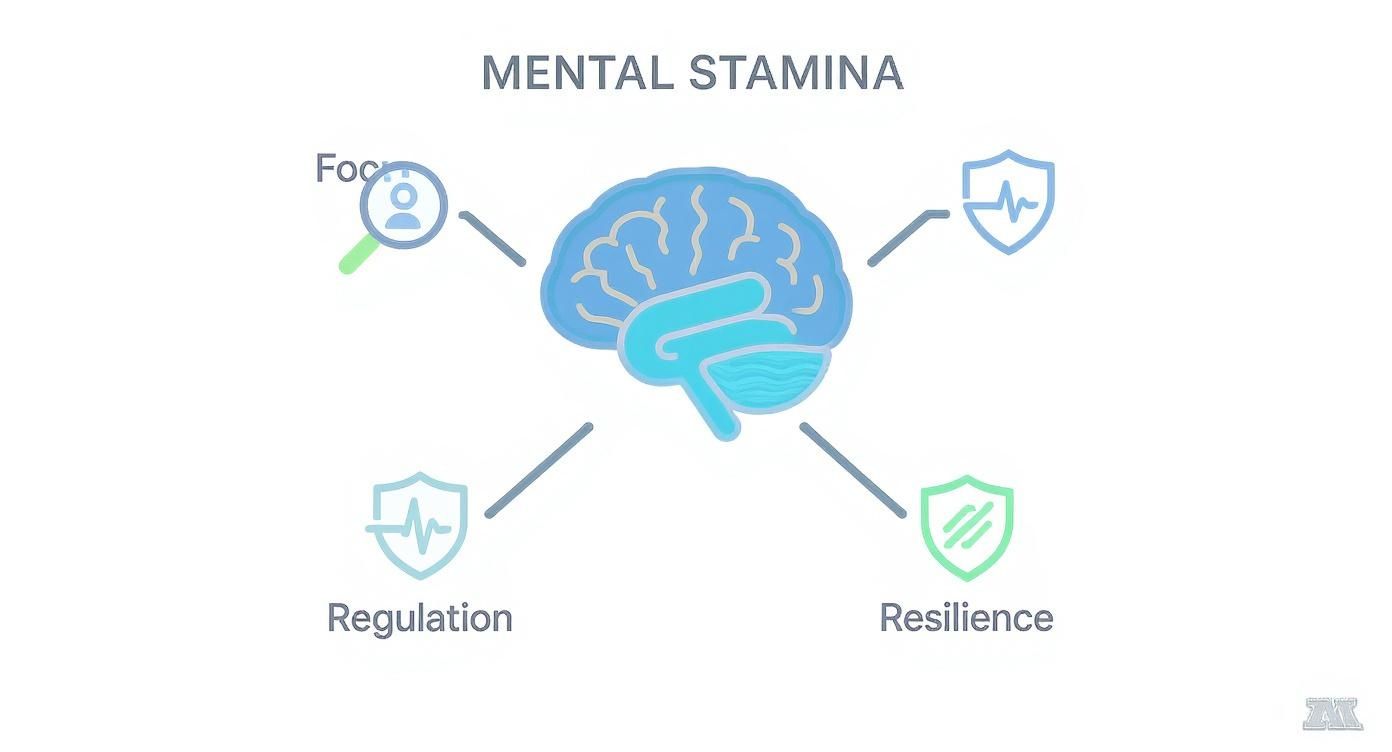
As you can see, focus, regulation, and resilience all work together to support your overall cognitive performance and toughness.
The Real Cost of Mental Fatigue
When your mental stamina runs low, you hit a wall. We call this mental fatigue, and it’s way more than just feeling tired—it's a measurable drop in your cognitive performance. Research shows it tanks your decision-making, kills creativity, and leads to a spike in errors.
A lot of us reach for a quick fix like another coffee, but that often backfires. The temporary jolt is usually followed by a harsh crash, creating a vicious cycle that drains your mental reserves even faster. Building real, lasting stamina requires sustainable strategies, not just a quick hit of caffeine.
The ability to bounce back from setbacks without losing confidence or focus is a cornerstone of mental toughness. It's understanding that difficulties are temporary parts of the growth process.
The Pillars of High Performance
To build serious mental stamina, you need to work on its core components. These aren't fixed traits you're born with; they are skills you can train and develop over time.
We can break mental stamina down into four key pillars. Each one plays a distinct role in helping you perform at your best, even when things get tough.
The Four Pillars of Mental Stamina
| Pillar | Description | Primary Goal |
|---|---|---|
| Focus | The ability to concentrate on a single task while tuning out distractions. | Achieve deep work and enter a "flow state" for peak productivity. |
| Emotional Regulation | The skill of managing emotional responses to stress, pressure, and unexpected events. | Remain calm and logical, making clear decisions even when the stakes are high. |
| Resilience | The capacity to recover quickly from adversity, setbacks, and failure. | View challenges as opportunities for growth instead of insurmountable obstacles. |
| Energy Management | The practice of conserving and deploying mental energy strategically throughout the day. | Avoid burnout and maintain consistent performance over long periods. |
By actively working on each of these pillars, you create a well-rounded foundation for high-level mental performance that you can rely on day in and day out. Here’s a closer look at a few of them:
-
Sharp Focus: This is your ability to lock onto a task and ignore all the noise around you. It’s absolutely critical for getting into deep work, that magical zone often called a "flow state" where your productivity and creativity skyrocket. Want to learn more? Check out our guide on how to achieve the flow state.
-
Emotional Regulation: This is all about keeping your cool. When you can manage your emotional responses to stress, you stay in control and make logical decisions instead of reactive ones. It's what separates the pros from the amateurs when things get heated.
-
Resilience: How quickly do you bounce back when you get knocked down? A resilient mind doesn't get derailed by setbacks. Instead, it sees challenges as a necessary part of the process—an opportunity to learn, adapt, and come back stronger.
Build a Resilient Mind with Physical Habits
Your brain’s performance isn't just a mental game—it's deeply wired into your physical health. If you're serious about improving mental stamina, one of the most powerful things you can do is build a rock-solid foundation of physical habits. This ensures your mind has all the resources it needs to stay sharp, focused, and resilient when the pressure is on.

This connection is direct and undeniable. The daily choices you make for your body have an immediate impact on your cognitive endurance. Simple acts like getting high-quality sleep, moving your body, and staying hydrated aren't just for physical wellness. They are non-negotiable for anyone chasing high-level mental performance.
Prioritize Deep and Restorative Sleep
Think of sleep as your brain's ultimate recovery tool. It's not just about clocking eight hours; it’s about the quality of that rest. Throughout the night, your brain cycles through different stages, and each one has a critical job to do for cognitive maintenance.
During deep sleep, for instance, your brain gets to work clearing out metabolic waste that accumulates while you're awake. REM sleep is absolutely crucial for memory consolidation, helping you process and lock in everything you’ve learned. If you skimp on these cycles, you're setting yourself up for brain fog and a much shorter cognitive fuse the next day.
Here are a few simple but effective ways to improve your sleep hygiene:
- Lock in a Wind-Down Routine: Dedicate the last 30-60 minutes before bed to screen-free activities. Read a physical book, do some light stretching—anything to signal that it's time to power down.
- Optimize Your Sleep Space: Your bedroom should be cool, dark, and quiet. This environment tells your body it’s time for restorative rest.
- Cut Off Stimulants Early: Stop drinking caffeine and eating heavy meals several hours before bedtime. This helps prevent disruptions to your natural sleep-wake cycle.
Leverage Exercise for Mental Endurance
Physical activity is one of the most potent tools for building both psychological and cognitive resilience. When you exercise, you aren't just training your muscles; you're actively conditioning your brain to handle stress and fatigue more effectively.
Aerobic workouts are especially powerful here. A brisk 30-minute run or cycling session increases blood flow to the brain, delivering a fresh supply of oxygen and nutrients that support neuron health. That boost can immediately clear away mental cobwebs and sharpen your focus.
But don't stop at cardio. Resistance training offers unique benefits for mental fortitude. Adding various exercises to your routine can significantly build physical resilience, which directly supports your mental stamina. Strength training quite literally teaches your mind how to push through discomfort, building the discipline you need for sustained mental effort.
A six-month study of university athletes revealed that progressive resistance training, performed just twice a week, led to a 24% decrease in depressive symptoms compared to a control group. Globally, about 31% of adults aren't meeting physical activity recommendations, which means many are missing out on this incredible mental health benefit.
The Critical Role of Hydration
Finally, never, ever underestimate the power of water. Even mild dehydration can seriously impair cognitive functions like concentration, memory, and decision-making. Your brain is approximately 75% water, and it needs a constant supply to run smoothly.
When you're dehydrated, your brain tissue can actually shrink temporarily, forcing it to work harder to perform even simple tasks. This extra effort rapidly drains your mental energy, making it much harder to maintain focus. The easiest fix? Keep a water bottle on your desk at all times as a visual reminder.
By weaving these physical habits into your daily life, you give your brain the essential support it needs to perform at its peak. When your body is well-rested, well-nourished, and active, your mind is far better equipped to tackle any challenge that comes your way. For athletes looking to take this a step further, you might want to check out our guide on supplements for endurance athletes.
Train Your Brain with Mental Conditioning
Just like hitting the gym builds muscle, you can train your brain’s ability to focus and endure. Mental conditioning isn’t about brute-forcing your way through exhaustion. It's about strategically building the skills that sharpen concentration and give you back control over your attention.
Think of it this way: you can lift random weights and get tired, or you can follow a structured program to get predictably stronger. The same logic applies to your mind. These exercises are your brain's training program.
Structure Your Focus with Timed Intervals
One of the smartest ways to build focus is to work with your brain's natural energy cycles, not against them. This is where timed work intervals, like the famous Pomodoro Technique, come in handy.
The method couldn't be simpler:
- Pick one single task. No multitasking allowed.
- Set a timer for 25 minutes and work on that task without interruption.
- Take a 5-minute break. When the timer rings, step away. Stretch, grab some water, look out the window.
- Repeat and rest. After four of these cycles (or "Pomodoros"), take a longer break of 15-30 minutes.
This approach trains your brain to lock in for short, intense bursts, making massive projects feel way less intimidating. It breaks a mental marathon down into a series of manageable sprints. For a writer, that might look like drafting for one 25-minute block and then editing in the next, which is a great way to blow past creative blocks.
Defeat Distractions with Single-Tasking
The myth of multitasking is one of the biggest saboteurs of mental energy. Sure, it feels productive, but constantly switching between tasks creates serious cognitive friction. Your brain has to reorient itself every single time, a process called "context switching" that absolutely torches your mental stamina.
The solution is deliberate single-tasking. This just means giving your full, undivided attention to one thing at a time. A project manager, for example, could block off an hour for budget analysis, turn off all notifications, and get the job done faster and with fewer errors.
Single-tasking isn’t about doing less; it’s about doing one thing exceptionally well. It builds the mental muscle needed to ignore distractions and achieve a state of deep work.
To take it a step further, you can utilize cognitive therapy thought records to identify and challenge the unhelpful thoughts that pull you off task and lead to mental burnout in the first place.
Strengthen Attention with Mindfulness
Think of mindfulness meditation as weight training for your attention span. The practice is simple: you focus on a single point—your breath is a great place to start—and gently guide your attention back whenever it wanders off.
Research shows that even a few minutes of daily meditation can strengthen the neural pathways tied to focus and emotional regulation.
This practice directly improves your ability to notice when you’re getting distracted and consciously pull your focus back to the task at hand. It's a foundational skill for anyone serious about building lasting mental endurance.
For more ways to sharpen your cognitive toolkit, check out our guide on how to improve cognitive flexibility.
Fuel Your Mind with Strategic Nutrition
Let's be real: what you eat isn't just fuel for your body; it's the raw material that powers your brain's performance. Moving past the usual clichés, strategic nutrition is a non-negotiable cornerstone for building real mental stamina. Every single meal and snack is an opportunity to either sharpen your cognitive edge or slide into brain fog and fatigue.

The connection here is direct and powerful. Your brain is an incredibly high-energy organ, burning through around 20% of your body's calories despite making up just 2% of your weight. Feeding it the right nutrients is absolutely essential for keeping your focus, memory, and overall mental endurance dialed in throughout a demanding day.
The Macronutrients of Mental Endurance
Your brain needs a steady, reliable supply of energy, and where that energy comes from matters immensely. Sure, simple sugars from processed junk might give you a quick spike, but they're always followed by a hard crash that completely torpedoes your focus.
For sustained mental stamina that actually lasts, build your meals around these key food groups:
- Complex Carbohydrates: Think oatmeal, quinoa, and sweet potatoes. These foods release glucose slowly, giving your brain a stable, long-lasting energy source. This prevents the sharp peaks and valleys that destroy concentration.
- Healthy Fats (Omega-3s): Your brain is nearly 60% fat, and omega-3 fatty acids are the critical building blocks for healthy brain cells. You'll find these high-quality fats in salmon, walnuts, and flaxseeds.
- Lean Proteins: Protein delivers the amino acids needed to produce neurotransmitters—the chemical messengers that regulate your mood, focus, and overall cognitive function. Chicken, beans, and eggs are perfect for keeping that mental communication sharp.
Brain-Protective Micronutrients and Foods
Beyond the big three macros, certain micronutrients play a huge protective role. They shield your brain from the daily stress that can wear down your mental performance over time. Antioxidants are especially important here, as they fight off the oxidative stress that damages brain cells.
By loading up on antioxidant-rich foods, you're actively defending your brain against daily wear and tear. Think of it as proactive defense—a key strategy for maintaining long-term cognitive health and stamina.
Try to work these brain-boosters into your weekly rotation:
- Blueberries: Often called "brainberries" for a reason. They're packed with antioxidants that have been shown to improve communication between brain cells.
- Leafy Greens: Spinach, kale, and broccoli are loaded with brain-healthy nutrients like vitamin K, lutein, and folate.
- Turmeric: This golden spice contains curcumin, a powerful anti-inflammatory compound that can cross the blood-brain barrier and directly support neuron health.
Amplify Your Efforts with Strategic Supplementation
While a nutrient-dense diet is your foundation, strategic supplementation can provide a serious boost, especially when you're facing intense mental demands. This is where targeted nootropics come in. They are designed to support the specific cognitive processes crucial for improving mental stamina.
These compounds enhance everything from neurotransmitter production to cerebral blood flow, giving you a cleaner, more sustainable edge than caffeine alone ever could. For a deeper look, check out our guide on the best supplements for mental clarity.
At Dialed In, our scientifically formulated nootropic products are crafted to complement your healthy lifestyle. Our Focus Pouches and Energy Gum deliver a precise blend of ingredients to support crash-free alertness and sharp focus. They're the perfect tool for high-performers looking to optimize their mental output and sustain peak cognitive endurance all day long.
Master Recovery to Prevent Mental Burnout
Real mental endurance isn’t about grinding until you drop. It's about knowing when to hit the brakes and recover intelligently. Peak performance works in cycles: intense effort, followed by intentional rest. Skipping that second part is the fastest path to mental burnout, where your thinking gets foggy and your drive just vanishes.
The key is to start treating rest as a non-negotiable part of your toolkit, not a guilty pleasure. But not all downtime is created equal. You have to know the difference between just zoning out and actively recharging.
Passive rest, like mindlessly scrolling through your phone, feels like a break but often just adds to the mental noise. In contrast, active recovery genuinely recharges your brain. These are the activities that let your mind actually wander and decompress.
Differentiate Your Downtime
To get recovery right, you have to be deliberate about how you spend your breaks. The mission is to find things that quiet the internal chatter, not just swap one type of stimulation for another.
-
Active Recovery: Think a walk outside, some light stretching, listening to instrumental music, or a few minutes of mindfulness. These activities give the prefrontal cortex—the part of your brain running all that high-level thinking—a much-needed break.
-
Passive Rest: This is where checking emails, doom-scrolling social media, or binging short-form videos falls. It might feel like a distraction, but it often keeps your brain on high alert and blocks any real cognitive reset.
Create Firm Boundaries with Psychological Detachment
One of the most effective recovery strategies is something called psychological detachment. It’s the skill of truly unplugging your brain from work when you’re not working. This is more than just leaving the office—it means mentally checking out. When you're constantly replaying work problems or sneaking a peek at your notifications, your brain is still on the clock.
A "digital sunset" is a powerful way to put this into practice. Pick a time every night—say, 8 PM—and shut down all work-related screens. This simple rule sends a clear signal to your brain that it's time to shift into recovery mode.
Making this a habit allows your cognitive resources to actually replenish, preventing that slow-burn fatigue that ultimately leads to burnout. It's a fundamental practice for anyone serious about building long-term mental stamina.
For an extra assist in that wind-down process, certain compounds like the amino acid L-theanine are known to promote a sense of calm alertness without making you sleepy. To learn more about how it works, check out our guide on what L-theanine is and its benefits.
Your Questions on Building Mental Stamina, Answered
Alright, let's get into some of the real-world questions that pop up when you start this journey. It's one thing to read about the theory, but it's another to apply it to your life, your job, and your unique brain chemistry.

Everyone's path is different, but the core principles of consistency and smart recovery hold true for anyone serious about building elite mental endurance.
How Long Until I Actually Feel a Difference?
You’ll start feeling the benefits in waves. The first shift is usually pretty quick. After just 1-2 weeks of nailing the basics—like getting enough sleep and staying properly hydrated—you should notice the daily brain fog starting to lift. You just feel... sharper.
The more noticeable gains in focus and resilience, the kind you can really lean on, often show up within 4-6 weeks of consistent mental and physical training. But remember, this is a lot like physical fitness. You don't just "get fit" and stop. You're building a lifestyle.
Building mental stamina is a marathon, not a sprint. Small, consistent efforts compound over time to create significant and lasting resilience.
Can I Really Build Stamina in a High-Stress Job?
Absolutely. In fact, a high-stress job is the perfect training ground. The goal isn't to get rid of stress—that's impossible. The key is to manage your response to it with smart recovery and hard boundaries.
This is where techniques like the Pomodoro method become your best friend during the workday. And when you clock out, you need to really clock out. Psychological detachment is a non-negotiable skill. Think of your job as an endurance race. The tougher the course, the more dialed in your training and recovery have to be.
Are Nootropics Safe? And Do They Work?
When chosen carefully, nootropics are a seriously effective tool for backing up your brain's performance. They’re not magic pills, but they are designed to work with your brain’s natural chemistry to sharpen focus, improve clarity, and extend your endurance on demanding days.
High-quality ingredients like L-Theanine and Citicoline have solid safety profiles, especially when you buy from a reputable source that cares about what goes into their products.
- How to Use Them: Think of nootropics as a performance supplement, not a replacement for a healthy lifestyle. They amplify the good habits you're already building.
- The Smart Approach: We always recommend checking with a healthcare professional before starting any new supplement, particularly if you have pre-existing health conditions.
They’re built to give a clean cognitive edge to people who need to sustain peak performance without the crash.
At Dialed In Nootropics, we engineer products for high-performers who refuse to compromise. Our Focus Pouches and Energy Gum deliver scientifically formulated support to sharpen your focus and push your mental endurance further. Explore our collection and find your edge at focuspouches.com.


